
Study MBBS Abroad Most Affordable MBBS Package
(Gyandeep NGO-Endorsed MBBS Scholarships Available)
NEET Syllabus: Physics, Chemistry and Biology
18 Feb, 2026, Jubair Alam, Mbbs Guidelines
Get Free Counselling
Enquire NowTable of Content
2. NEET Physics syllabus
3. NEET Chemistry syllabus
4. NEET Biology syllabus
5. NEET 2024 and 2026 syllabus
6. Subject-wise preparation for NEET
7. Mistakes to Ignore while Preparing for NEET
8. Exam pattern for NEET
9. Covering NEET syllabus effectively
10. Conclusion
11. Faqs
NEET Syllabus: Physics, Chemistry and Biology
Becoming a successful doctor is a dream come true for every medical aspirant? For this you have to get admission in the finest medical colleges. To get admission in the best medical colleges you need to crack the NEET exam. Cracking the exam clears your path for the best medical courses. Hence, prepare for the exam very well and sacrifice some curricular activities. Remember that you have to do well in this exam and prove yourself that you are worth it. However, before going any further you have to deep dive into the NEET syllabus. In this article, we will tell you about the syllabus for Physics, Chemistry and Biology.
An overview of the NEET syllabus
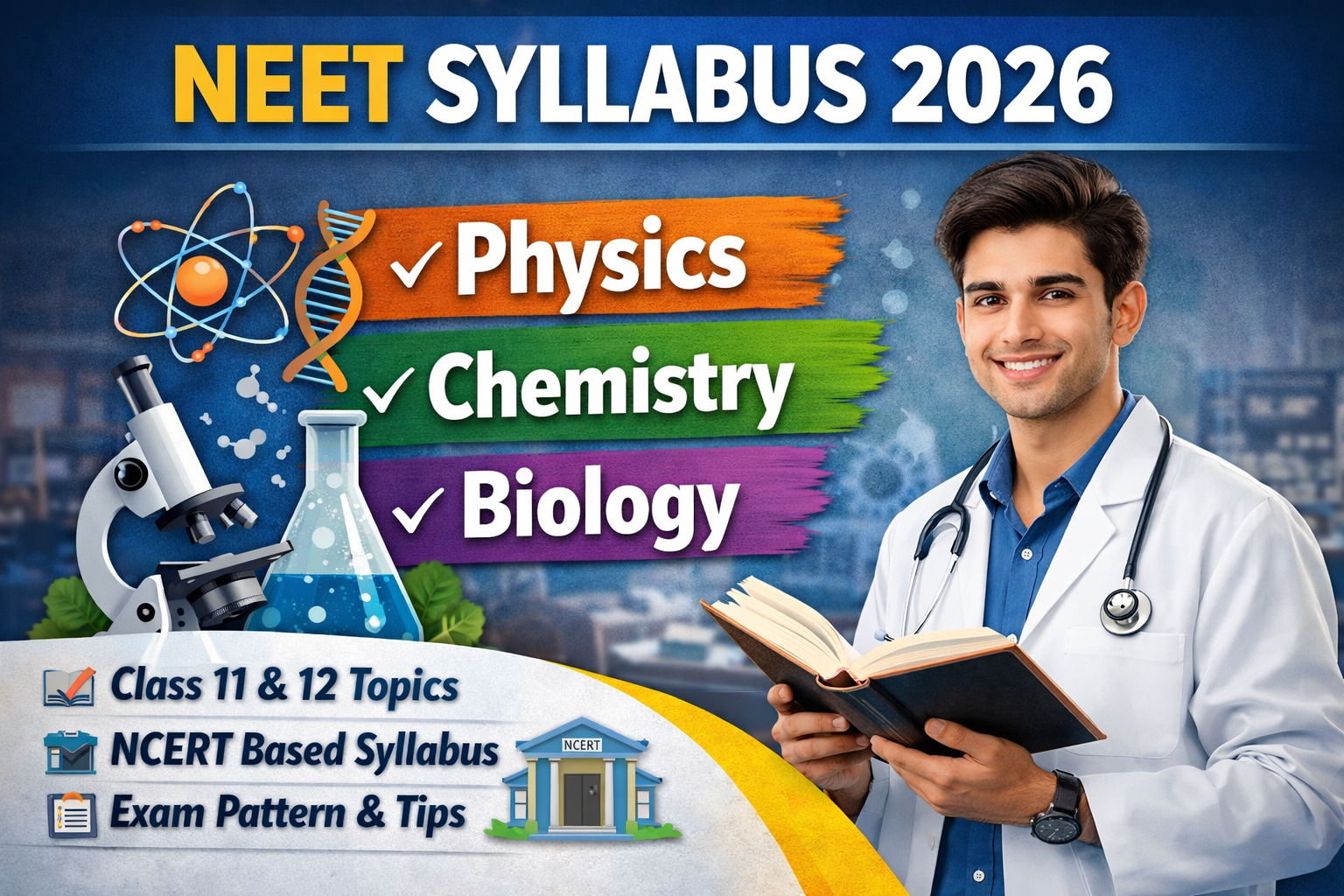
The NEET syllabus 2026 have mainly been prepared with reference to the NCERT syllabus of Class 11 and 12. The NTA publishes the NEET exam syllabus every year. It is more or less the same as NCERT books. But sometimes changes might be made and students should refer to the latest edition.
In the NEET syllabus, you will get:
- Class 11 and 12 Physics
- Class 11 and 12 Chemistry
- Botany and Zoology, Class 11 and 12 Biology
The basic framework of the NEET syllabus is similar to that of the previous year. It will include the NEET syllabus 2024, and students must be aware of all recent changes.
NEET Physics syllabus
It is certain that Physics comes with numerical problems and formulas. You cannot compromise with these. They are an essential part of the subject and carry plenty of marks. For majority of the students numerical problems and formulas are the toughest part. However, you have to practice them regularly and ensure that you are well-versed with them. Here is the NEET physics syllabus:
Class 11 topics
Physics and Measurement
- Units and Measurements
- Dimensional Analysis
Kinematics
- Motion in a Straight Line
- Motion in a Plane
Laws of Motion
- Newton’s Laws
- Friction
- Circular Motion
Work, Energy and Power
- Work-Energy Theorem
- Potential and Kinetic Energy
Rotational Motion
- Torque
- Angular Momentum
Gravitation
- Universal Law of Gravitation
- Kepler’s Laws
Properties of Bulk Matter
- Elasticity
- Fluid Mechanics
- Surface Tension
Thermodynamics
- Laws of Thermodynamics
- Heat Transfer
Oscillations and Waves
- Simple Harmonic Motion
- Wave Motion
Class 12 topics
- Electrostatics
- Current Electricity
- Magnetic Effects of Current and Magnetism
- Electromagnetic Induction
- Alternating Current
- Optics (Ray & Wave)
- Dual Nature of Matter and Radiation
- Atoms and Nuclei
- Electronic Devices
NEET Chemistry syllabus
Chemistry combines physical, organic and inorganic chemistry. When it comes to physical chemistry, there are mathematical problems and formulas. For the conceptual facts, you need to rely upon the organic part. On the other hand, the inorganic part needs a thorough memorisation and conceptual understanding. Here is the NEET Chemistry syllabus:
Physical Chemistry (Class 11 & 12)
- Some Basic Concepts of Chemistry
- Atomic Structure
- Thermodynamics
- Equilibrium
- Redox Reactions
- Solutions
- Electrochemistry
- Chemical Kinetics
Organic Chemistry
- Basic Principles and Techniques
- Hydrocarbons
- Haloalkanes and Haloarenes
- Alcohols, Phenols and Ethers
- Aldehydes, Ketones and Carboxylic Acids
- Biomolecules
- Polymers
- Chemistry in Everyday Life
Inorganic Chemistry
- Classification of Elements
- Chemical Bonding
- p-Block Elements
- d- and f-Block Elements
- Coordination Compounds
- Environmental Chemistry
NEET Biology syllabus
Biology carries a higher weightage in the NEET syllabus. It is theory-based, and you have to go through the diagrams. You have to prioritise Biology and focus on the NCERT books. Try not to rely on reference books too much. Focus on the NCERT books, as most questions come from them. Here is the NEET Biology syllabus:
Class 11 Biology Topics
- Diversity in Living World
- Structural Organisation in Animals and Plants
- Cell Structure and Function
- Plant Physiology
- Human Physiology
Class 12 Biology Topics
- Reproduction
- Genetics and Evolution
- Biology and Human Welfare
- Biotechnology and its Applications
- Ecology and Environment
NEET 2024 and 2026 syllabus
The NEET syllabus 2024 had minor rationalization of the topics. There is no doubt that the topics were adjusted as per the latest NCERT books. In 2026 the NEET syllabus will be following the same. It has been observed that:
Core topics are not changed
The NEET syllabus 2024 introduced rationalisation through content changes, which have now been aligned with the current NCERT textbook standards. The main conceptual areas were not eliminated through this process because the NEET examination needs to assess all essential fundamental concepts. This method enables students who studied for previous NEET exams to keep using their existing study methods, as they only need to modify them
NCERT is the Backbone
The NEET syllabus depends completely on the NCERT textbooks which cover both Class 11 and Class 12 material. Undoubtedly, the NEET syllabus 2024 has introduced changes. However, the NCERT is the most important reference for Biology, backbone for the Chemistry concepts and conceptual base for the Physics formulas.
Mark Weightage is Consistent
It has been observed that the mark distribution has not changed over the years. As per the NEET syllabus, Biology carries 360 marks, Physics and Chemistry carry 180. There is no change in the subject-wise distribution. There was a rationalisation in the 2024 syllabus. However, the relevance of the subject chapters is the same. Candidates need to prepare according to the syllabus pattern and experience a similar weightage pattern. This is how the candidates can prepare accordingly.
No certain deviations in the exam pattern
The NEET exam pattern has not changed over the past few years. The overall structure of the examination remains unchanged. NEET syllabus has changed, but there has been no impact on the pattern. This way, students can focus more on studying rather than thinking about the pattern.
Subject-wise preparation for NEET
You also need to know the subject wise preparation for NEET. Besides knowing the NEET syllabus you have to be aware of the subject-wise strategy of preparation. You cannot overlook this thing. It is an easier path to crack the NEET exam.
Physics
Certainly, Physics is the toughest subject in the NEET exam. It contains mathematical problems and formulas that need to be prioritised. Understand and memorise the important formulas. Practice the mathematical problems. Go through the solved multiple choice questions. Revise the syllabus as much as you can. Solve the Physics sample test papers numerous times.
Chemistry
For Chemistry, the best thing is to mug up the NCERT book. Majority of the NEET syllabus is dependent upon the NCERT book. Reaction mechanisms may be tough, but they cannot be overlooked. Go through the inorganic chemistry part again and again. Ensure to prioritise
Physical Chemistry numericals.
Biology
Unlike Chemistry, the same strategy is also used for Biology. Therefore, go through the NCERT textbook. Be thorough with the diagrams, and the assertion-reason questions are a must. Another thing is that you can also make detailed notes on whatever you studied. Never ignore anything.
Mistakes to Ignore while Preparing for NEET
It has been observed that some candidates make a few mistakes while preparing for NEET. These mistakes cannot be made. Mentioned below are the mistakes:
Overlooking the NCERT books
As already mentioned, the majority of the NEET syllabus is based on the NCERT books. Never think that the NCERT textbooks are not important. Give importance to these books. The best thing is to memorise them properly. You have to be thorough with the book. In Biology, these books have all the necessary details and diagrams. Never ignore these diagrams as they are very important.
Ignoring Revision
Not revising regularly is a serious mistake that cannot be made. The NEET exam requires students to revise three main subjects, which make up the entire syllabus. This revision needs to be done twice or thrice. The absence of regular revision leads to substantial memory loss, according to scientific research.
Not going through the official syllabus
Extra topics, other than the prescribed NEET exam syllabus, are prepared by some of the students, considering that more topics will give them an edge. NEET follows the official syllabus. You can download the syllabus from the NTA website and prepare a checklist of the topics. If you focus on the official syllabus you are doing smart work.
Neglect mock tests
Students need to practice NEET mock tests. The focus should not only be on completing the NEET syllabus. The major blunder occurs as they are also required to learn and apply things differently with the help of separate skill sets. Mock tests allow the students to evaluate their performance very well. It allows them to rectify where they are wrong. Therefore, mock tests cannot be ignored.
Multiple reference books
You have to rely only on one reference book. Relying on multiple reference books gives you different answers, which can confuse you. It is said to rely more on the NCERT books. Half of the questions come from these books. In other words, the NCERT book is the backbone of NEET exam preparation.
Exam pattern for NEET
You also need to understand the NEET exam pattern. Understanding the exam pattern gives you a proper idea.
- Mode: Offline
- Duration: 3 hours 20 minutes
- Total Questions: 200 (180 to be attempted)
- Subjects: Physics, Chemistry and Biology
- Marking Scheme:
- each correct answer
- -1 for+4 for each incorrect answer
6.Total Marks: 720
Covering NEET syllabus effectively
To know how to cover the NEET syllabus effectively, you need to go through the following points. This is how you can cover the NEET syllabus effectively.
Divide the syllabus
One of the best things is to divide the syllabus into two parts. You can allocate 2 to 3 chapters per week for Biology. On the other hand, you can allocate 1 to 2 chapters per week for Physics and Chemistry. When it comes to revision and mock tests, the last week is enough. Once you draft a timeline of your study routine, it will be easier for you to prepare.
Prioritise Biology
The Biology subject covers 360 marks from a total of 720 marks which constitutes 50 percent of the total examination marks according to the NEET exam pattern. Hence, it requires more preparation time. You can revise whatever you have studied. The NEET exam syllabus majorly includes Biology which means students who excel in this subject will achieve higher overall rankings.
Analyse mistakes
Taking mock tests without analysis is not effective. Real changes happen during the analysis of tests taken. Therefore, it is better to analyse where you went wrong. This is how you can rectify your mistakes and not repeat them. Students often take this matter casually but it needs to be taken seriously.
Conclusion
Therefore, you have to start preparing for NEET from today. The NEET exam syllabus provides a complete understanding of the exam requirements. While students who master the Physics syllabus and follow the exam pattern will boost their success rate. The exams are knocking on your door, so prepare thoroughly. Never take this thing casually, as getting admission in the best MBBS college depends on it. Sacrifice other activities and dedicate most of your time to studies. Grab this opportunity now.
FAQ
No, the exam is meant for candidates aged 17 or above. A candidate under 17 years of age cannot apply.
A 60 year old person can take the NEET exam because the National Medical Commission eliminated the upper age limit. Anyone aged 17 or older is eligible for the test.
Yes, preparing for a 700+ score in NEET in just 3 months is extremely challenging. However, it is possible through a highly focused, disciplined approach.
No, coaching is not necessary for someone to crack the exam. You need to have your preparation plan so that things work out smoothly.
Last year, 12.36 lakh students cracked the exam. Some students think it is impossible to crack the exam but it is not. You can easily crack it if you're dedicated.


