


MBBS in Georgia is becoming a popular option for Indian students who want to study medicine abroad. In Georgia, the medical degree is called MD (Medical Doctor) rather than MBBS. The growing interest in MBBS in Georgia is reflected in recent data. According to NITI Aayog’s report on the Internationalization of Higher Education in India, the number of Indian students in Georgia increased sharply from 5,992 in 2020 to 16,093 in 2024. This growth highlights Georgia’s rising popularity among Indian students seeking medical education abroad.
So, why are students choosing MBBS in Georgia?
English-taught medical programs, a European learning environment, a diverse student community, and relatively manageable education costs make it an option worth considering. The Georgia MBBS fees vary widely, with most programs charging an approximate fee between $4,000-$8,000 per year or nearly Rs. 3.3 lakh-Rs. 6.6 lakh, depending on the university and exchange rates.
But choosing a medical university abroad is a major decision, and fees should not be the only deciding factor. Students should also check the university's current recognition, course structure, clinical training, admission requirements, total expenses, and the rules they will need to follow if they plan to practice medicine in India after graduation.
Let’s discuss why students choose MBBS in Georgia, course eligibility and admission requirements, Georgia MBBS fees, medical universities, course duration, living costs, recognition in India, and career options after graduation.
Georgia introduced changes to its higher-education admission framework in 2025, which has created uncertainty around new international admissions at some public universities. Some reports have stated that public universities may restrict new foreign admissions, while private universities continue to accept international students. However, TSMU's current official website continues to publish an admission procedure for international students, so students should not rely on blanket claims or outdated reports.
Verify before you pay. Indian students should confirm directly with their chosen university whether it accepts new Indian applicants for the intended intake, along with the current program, tuition fee, eligibility criteria, and admission deadline. Students should also verify the applicable NEET and NMC requirements before making any financial commitment.
Here are the key facts about MBBS in Georgia, including course duration, eligibility, fees, admission, and recognition requirements.
| Factor | Quick Answer |
|---|---|
| Country | Georgia |
| Popular City for MBBS in Georgia | Tbilisi |
| Degree | Medical Doctor (MD) at many universities (equivalent to MBBS in Georgia) |
| Georgia MBBS Duration | Program-specific; many medical programs follow a 6-year structure |
| Medium of Instruction for MBBS in Georgia | English-medium options are available |
| MBBS in Georgia Eligibility for Indian Students | Subject to university and applicable Indian regulatory requirements |
| NEET | Indian students must meet the applicable NEET requirements |
| Annual Tuition Fees | Approximately $4,000–$8,000 (Rs. 3.3 lakh–Rs. 6.6 lakh) per year, depending on the university and program |
| Total Tuition Fees | Depends on the university, course duration, and annual fee structure |
| Living Costs | Depend on the city, accommodation, and lifestyle |
| MBBS in Georgia Admission Process | University-specific |
| Clinical Training | Structure and duration vary by university and program |
| Internship | Depends on the program structure and applicable requirements |
| MBBS in Georgia Recognition & Eligibility | Verify the current status of the specific university and medical program |
| Practice in India After Graduation | Subject to current National Medical Commission (NMC) requirements |
| Best For | Students seeking international medical education and English-medium study options |
Georgia has introduced changes to international-student admissions at state-funded universities for the 2026–27 academic year. For students planning MBBS in Georgia, these changes can affect university selection, language requirements, admission procedures, and residence status.
Indian students should therefore verify whether their chosen public university accepts new international applicants before applying. Private Georgian universities may continue to accept international students, subject to their individual admission policies. Indian applicants must also meet the applicable NMC requirements, including NEET qualification and current foreign medical graduate licensing requirements.
However, students should not treat this as a blanket closure of every public medical university. TSMU currently publishes an international admission procedure and requires international applicants to submit a recognised B1 English certificate.
MBBS in Georgia for Indian students offers an alternative route to medical education through English-taught programs, varied university options, and comparatively manageable study costs.
Here are the key reasons students consider MBBS in Georgia:
Georgia MBBS fees vary by university, but several programs offer comparatively manageable tuition. Students should also budget for accommodation, food, transportation, insurance, and other living expenses when calculating the cost of MBBS in Georgia.
Many Georgia medical universities offer medical programs in English, allowing international students to complete their studies without using Georgian or Russian as the primary teaching language. Learning basic Georgian can still help with everyday and clinical communication.
Students from different countries study MBBS in Georgia, creating a multicultural environment. Indian students can gain international exposure while interacting with peers from diverse backgrounds while pursuing MBBS in Georgia.
The process of MBBS admission in Georgia is relatively simpler and based on academic eligibility and document submission. Students should still meet all applicable requirements, including those related to NEET and foreign medical education.
Studying MBBS in Georgia gives students exposure to a European academic and cultural environment. This can broaden their understanding of different healthcare systems and cultures.
Georgia offers a welcoming environment for international students. Before choosing a Georgia MBBS university, students should research the safety, accommodation, transportation, and student support available in its location.
Students who aspire to pursue MBBS in Georgia can compare a huge number of Georgia medical universities based on fees, location, curriculum, clinical training, facilities, teaching language, and student support before making their choice.
Note: Students who wish to study MBBS in Georgia should verify the specific university and medical program against current official requirements rather than assuming that every institution has the same recognition status. Indian students should also check the latest NMC requirements for foreign medical graduates before enrolling.
To study MBBS in Georgia, applicants generally need 10+2 with Physics, Chemistry, Biology, and English, meet the applicable age and academic requirements, and submit the required documents. Indian students must also meet the applicable NEET and NMC requirements for their intended medical career pathway in India.
Here are the key eligibility requirements for MBBS in Georgia that applicants should check before applying.
| Eligibility Requirement | Details |
|---|---|
| Age | Applicants should generally be at least 17 years old by December 31 of the admission year. |
| Academic Qualification | Complete 10+2 or an equivalent qualification with Physics, Chemistry, Biology, and English. |
| Minimum PCB Marks | Generally 50% aggregate for the General Category and 40% for applicable Reserved Categories, subject to the university and current regulations. |
| NEET | Indian students must meet the applicable NEET requirement, particularly if they intend to pursue medical registration in India after graduation. |
| English Proficiency | Many universities offer English-taught medical programs. IELTS or TOEFL may not be required at some universities, while others may assess English through an interview or their own process. |
| Passport | A valid passport is required for international admission and visa processing. Some admission providers recommend at least 18 months of validity, but students should follow the current visa and university requirements. |
| Medical Fitness | A medical fitness certificate may be required during admission or visa processing. |
| Class 10 Documents | Class 10 marksheet and certificate may be required to verify academic history. |
| Class 12 Documents | Class 12 marksheet, certificate, or equivalent academic transcripts are generally required. |
| NEET Documents | Indian applicants should provide their NEET scorecard/certificate where required. |
| Additional Documents | Universities may request photographs, application forms, identity documents, or other supporting records. |
| University-Specific Criteria | Admission requirements can differ between universities, so applicants should verify the latest criteria directly with their chosen institution. |
| NMC Requirements | Indian students should check the latest NMC rules for foreign medical graduates before admission to ensure the chosen program aligns with their intended pathway in India. |
The MBBS admission in Georgia process typically includes choosing a university, checking eligibility, submitting documents, receiving an offer, completing immigration formalities, and finalizing enrollment.
Here are the key steps to apply for MBBS in Georgia, from university selection to starting your medical program.
Your university choice affects your curriculum, clinical training, costs, and future licensing options, so evaluate the MBBS in Georgia university before submitting an application. Tuition and other costs, including the latest Georgia MBBS fees, should be compared before choosing a university.
Here are the key factors to check when choosing a medical university in Georgia:
For MBBS in Georgia for Indian students, NMC specifically advises due diligence before joining a foreign medical institution and warns that differences in course duration, medium of instruction, curriculum, clinical training, or internship arrangements can affect eligibility for registration in India.
Before applying to any program of MBBS in Georgia, make sure you meet both the university's admission criteria and the requirements that apply to Indian students planning to study medicine abroad. Students should also understand the Georgia MBBS fees and other financial requirements before applying.
Here are the main requirements to review and documents to prepare for taking admission to MBBS in Georgia:
Do not assume that one eligibility checklist applies to every university. Confirm the exact requirements for your chosen program of MBBS in Georgia before submitting your application.
Once you have confirmed your eligibility, submit your MBBS in Georgia application through the university's official application channel. Check the applicable Georgia MBBS fees and application charges before submitting the application.
Here are the usual steps for submitting an application for MBBS admission in Georgia:
After reviewing your MBBS in Georgia application, the university may issue an offer or admission letter if you meet its requirements. Review the Georgia MBBS fees, payment schedule, and other charges before accepting the offer.
Here is what you should check before accepting an admission offer for MBBS in Georgia:
After accepting the offer, you may need to complete additional university or Georgian education-authority procedures before travelling. Confirm the Georgia MBBS fees and required initial payment with the university
Here are the formalities that may apply at this stage of MBBS in Georgia admission:
Note: Do not assume that every applicant will receive or need the same type of invitation document for MBBS in Georgia. Follow the process specified by your university and the relevant Georgian authorities.
Once you have the necessary admission documents for MBBS in Georgia, complete the immigration formalities applicable to your study situation. Students should keep sufficient funds available to meet their Georgia MBBS fees and living expenses.
Here are the documents you may need for taking admission in MBBS in Georgia, depending on the current requirements:
Important Note: Check the current requirements before applying for MBBS in Georgia because immigration procedures and documentation can change.
After completing the required immigration formalities for studying MBBS in Georgia, arrange your travel and prepare for your arrival. Before travelling, make sure you have planned for Georgia MBBS fees, accommodation, travel, and other expenses.
Here are the practical arrangements to make before travelling:
Your process for MBBS admission in Georgia is not complete until you finish the university's final registration and document verification procedures. Pay any outstanding Georgia MBBS fees or other university charges required for registration.
Here are the final steps you may need to complete after reaching Georgia:
Please Note: MBBS in Georgia Admission timelines, eligibility criteria, document requirements, tuition fees, university policies, and immigration procedures can change. Always confirm the latest information directly with your chosen medical university, the NMC where applicable, and the relevant Georgian authorities before applying, making payments, or travelling.
The MBBS in Georgia generally takes six years to complete, although the curriculum, ECTS credits, clinical training, and graduation requirements can vary by university. Georgia medical universities typically award a Medical Doctor (MD) qualification rather than a degree literally titled MBBS. For students planning MBBS admission in Georgia, it is important to check the official program structure, duration, and entry requirements of the university before applying.
A six-year Medical Doctor program in Georgia (equivalent to MBBS in Georgia) generally combines basic medical sciences, preclinical education, clinical sciences, practical learning, and supervised clinical training. The exact sequence of subjects and clinical exposure depends on the curriculum of the individual Georgia medical university.
For students considering MBBS in Georgia for Indian students, the program can generally be understood through the following stages.
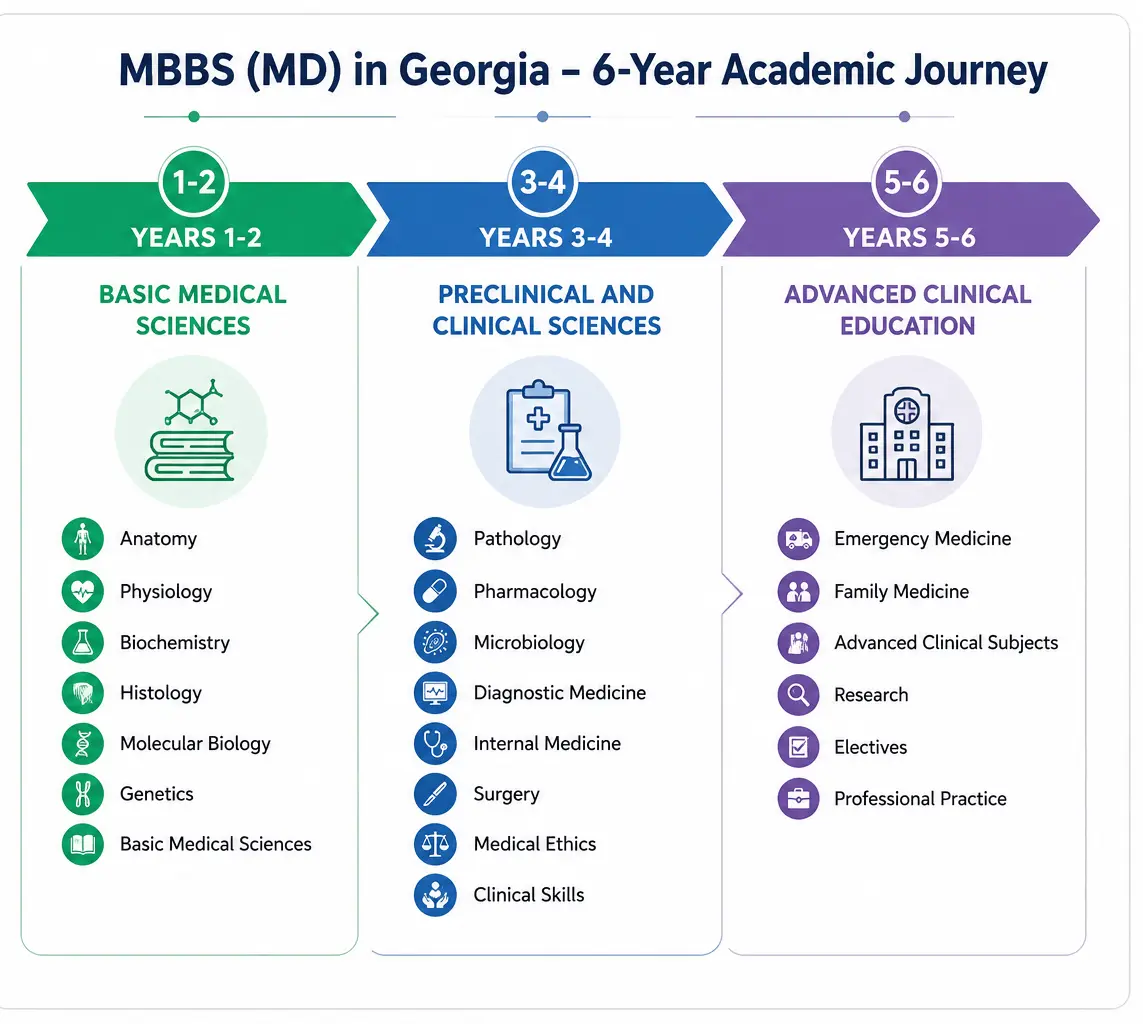
The first two years of MBBS in Georgia generally focus on foundational medical sciences that prepare students for clinical education in later stages of the program.
Depending on the university, students may study:
These subjects provide the scientific foundation needed to understand human health, disease processes, diagnosis, and treatment.
The middle stage of MBBS in Georgia for Indian students generally progresses from foundational sciences toward clinical and patient-oriented education, although the exact timing varies between universities. Students may begin integrating theoretical knowledge with practical and clinical skills through laboratory work, workshops, simulations, and supervised learning.
Depending on the MBBS in Georgia curriculum, subjects may include:
The exact subjects, semester structure, and timing of clinical exposure should be confirmed through the official curriculum of the selected university.
The final stage of MBBS in Georgia generally places greater emphasis on clinical education, patient management, diagnosis, treatment, and supervised practical experience. Depending on the university, students may undertake clinical rotations, clerkships, practical training, or other forms of clinical education at university hospitals, teaching hospitals, or affiliated healthcare institutions.
The later stages of MBBS in Georgia for Indian students may also include areas such as:
The specific clinical requirements differ between Georgia medical universities, so students should review the official program details before admission.
No, MBBS in Georgia is generally six years long, but its ECTS requirements, curriculum organization, clinical training, and graduation requirements can differ between universities. For example, official university program information reveals the varying structures of medical schools throughout Georgia. TSU has its English Medicine program at 6 academic years, 12 semesters and 362 ECTS, whereas New Vision University has its Medical Doctor program at 6 years and 360 ECTS. TSMU lists its American MD Program as 6 years and 360 ECTS as well.
Thus, it is important for students who want to take MBBS admission in Georgia to confirm the university’s duration, ECTS, clinical training, and graduation requirements instead of relying on the fact that all MBBS in Georgia programs are the same.
Popular medical universities for MBBS in Georgia offering English-taught Medical Doctor programs include major institutions such as Tbilisi State Medical University, Ivane Javakhishvili Tbilisi State University, New Vision University, Caucasus International University, University of Georgia, European University, Akaki Tsereteli State University, and Georgian National University (SEU).
The Ivane Javakhishvili Tbilisi State University (TSU) has an English-medium, one-cycle program in Medicine that leads to a Medical Doctor (MD) qualification. Its MBBS in Georgia program has a duration of 6 academic years, 12 semesters, and 362 ECTS credits.
The MBBS in Georgia program from TSU aims to equip medical graduates for clinical practice and other professional development. Its curriculum includes biomedical sciences, clinical sciences, population health and health systems, professional ethics and communication, critical thinking, scientific research, and information management.
For students planning MBBS admission in Georgia, TSU has also set practical learning outcomes for its graduates. Students understand how to analyze a clinical case, formulate an investigative plan, create a differential diagnosis, derive a management plan for a patient, provide urgent/emergency care, communicate with patients and colleagues, and practice evidence-based principles.
Key details:
The Akaki Tsereteli State University (ATSU) offers a one-cycle Medical Education Program in English, upon completion of which a student will graduate with the Medical Doctor qualification.
ATSU’s Faculty of Medicine teaches MBBS in Georgia in both English and Georgian. The university claims that it offers students opportunities for learning, teaching, and research that are contemporary, according to higher standards of education.
For students exploring MBBS admission in Georgia, the official ATSU MBBS in Georgia curriculum includes required subjects in core medical and clinical sciences. The study schedule includes medical biology, medical biochemistry, anatomy, histology, physiology, clinical ethics, observation at a primary health care facility, and problem-based learning.
Key details:
New Vision University provides a six-year Medical Doctor (MD) program (equivalent to MBBS in Georgia), which is taught in English, has 360 ECTS credits, and lasts six years. The university employs an outcome-based system of education that integrates medical knowledge, clinical skills, practice, research, and professional values.
For students considering MBBS admission in Georgia, the curriculum for students is sequenced in four loops; each stage loops back on the knowledge and skills acquired previously. The first loop includes anatomy, physiology, imaging, biochemistry, molecular biology, histology, clinical skills, and research methods. The second loop of this MBBS in Georgia course introduces subjects such as pharmacology, systemic pathology, physical diagnosis, family medicine, and general surgery.
NVU also has a strong focus on hands-on training. Official documentation of its program requires that graduates receive a minimum of 5,500 hours of medical training. Attendance in every module should never be less than 80% in order to graduate. For students comparing Georgia MBBS fees, checking the university’s current official fee structure is essential before applying.
Key details:
Caucasus International University (CIU) has been running its Faculty of Medicine since 1995 and has programs accredited in Georgian and English for medical education. It claims that its Facultad de Medicina is listed in the World Directory of Medical Schools.
CIU is accredited to offer a 6-year-long Medical Educational Program in English, leading to the qualification of Medical Doctor (MD). This MBBS in Georgia program has 360 credits, 12 semesters, and covers the study of basic medical sciences, clinical education, clinical skills, scientific research skills, and elective courses in a structured way. CIU designates 123 credits for basic education courses, 168 for clinical education courses, 10 for scientific skills, and 24 for clinical skills.
For students planning MBBS admission in Georgia, CIU provides practical learning facilities, including an Anatomy Lab, a Biochemistry Teaching Lab, a Microbiology Teaching Lab, along with a Clinical Skills Center. The Clinical Skills Center employs medical mannequins and simulators for students to practice clinical and communication skills. Students comparing Georgia MBBS fees should also check CIU’s latest official fee structure before applying.
Key details:
Tbilisi State Medical University (TSMU) has an American MD (USMD) Program that is taught in English and results in a Medical Doctor (MD) degree. It is a 360 ECTS credits-long program with an academic duration of 6 years, divided into 12 semesters. The program was developed by TSMU together with the Emory University School of Medicine in Atlanta, USA.
This MBBS in Georgia course includes basic medical sciences, pre-clinical studies, clinical disciplines, research, and clinical training. TSMU also designed the curriculum according to current standards in medical education, including clinical components and research.
For MBBS admission in Georgia at TSMU, international applicants who enter the English-language program without Georgian Unified National Exams must demonstrate English proficiency. TSMU accepts applicants who have completed secondary or higher education in English or achieved IELTS above 6.5 or TOEFL above 90. Other applicants must take the university's English proficiency test.
Key details:
UG, Universidad de Georgia, offers an English Medical Education (MD) program as a single-cycle medical program. This MBBS in Georgia program carries 360 ECTS credits and runs for six years.
It combines classroom theory, lab studies, and hands-on practice, making MBBS in Georgia for Indian students a practical education pathway. Students participate in clinical rotations in medical disciplines through the university and its affiliated medical institutions. UG applies a mentorship-guided approach for practical training and assesses clinical and professional competencies using structured evaluations within simulations and in clinical environments.
Key details:
European University also has a Medical Doctor degree program in English specifically designed for MBBS in Georgia for Indian students. It is a 6-year and 360 ECTS program. This integrated course of MBBS in Georgia is comprised of medical science, supervised medical practice, clinical education, and research to help the growth of the students’ medical knowledge and clinical skills.
For students who wish to study MBBS abroad, the university also has international academic relations and offers Erasmus+ mobility programs and other international programs to students. These opportunities can provide students with additional academic and cultural experiences while they study MBBS in Georgia.
Key details:
SEU Georgian National University offers a one-cycle Medicine program, in English, that qualifies medical graduates as Medical Doctors. It is also an accredited MBBS in Georgia program, and it is worth 360 ECTS credits.
The program lasts 6 years and is divided into 12 semesters. Students who complete all 360 ECTS required credits of the Medical Education Program are awarded the Medical Doctor degree by SEU. For international students, English serves as the language of instruction for MBBS in Georgia. According to SEU’s official English-taught programs document, the Georgia MBBS fees for the Medical Doctor program for foreign citizens are $5,900 per year. Indian students should consider applying for MBBS admission in Georgia at SEU after evaluating admission, NEET, and NMC eligibility criteria.
Key details:
The Georgia MBBS fees typically range from around $4,000 to $8,000 per year in tuition at several medical universities, while some programs charge more. The total cost also includes accommodation, food, health insurance, transportation, visa or residence expenses, flights, study materials, and personal spending. For Indian students, Georgia MBBS fees vary by university, program, and fee policy. Therefore, students should compare both tuition and living expenses before selecting a medical university for MBBS in Georgia.
The following table compares published tuition figures for selected English-taught MBBS in Georgia.
| University | Medical Program | Duration | Published Georgia MBBS Fees (Annual) | Official Reference |
|---|---|---|---|---|
| Ivane Javakhishvili Tbilisi State University (TSU) | Medicine, English Program, MD | 6 years / 12 semesters | $8,000 | TSU – Medicine (English Program) |
| Akaki Tsereteli State University (ATSU) | One-Cycle Medical Education, Medical Doctor | 6 years / 12 semesters | $4,000* | ATSU – Medical Doctor Program |
| New Vision University | Medical Doctor (MD) | 6 years / 360 ECTS | $7,000 | New Vision University – Medical Doctor Program |
| Caucasus International University (CIU) | Medical Educational Program in English | 6 years / 360 credits | $6,000 | CIU – International Programs |
| Tbilisi State Medical University (TSMU) | American MD Program | 6 years / 360 ECTS | For Georgian citizens - 8,000 GEL; Non-Georgian citizens – 13,500 USD | TSMU – American MD Program |
| University of Georgia (UG) | Medical Education (MD), English | 6 years | $6,500 | University of Georgia – Tuition & Fees |
| European University | Medical Doctor (MD) | 6 years / 360 ECTS | $6,500 | European University – International Students & Programs |
| Georgian National University (SEU) | One-Cycle Medicine, Medical Doctor | 6 years / 360 ECTS | $5,900 | SEU – Medicine Program Catalogue |
Fee Note: The figures above are based on tuition information published by the respective universities at the time of writing. Georgia MBBS fees, payment schedules, and other charges can change, so verify the latest fee structure directly with the university before applying or making a payment.
Georgia MBBS fees generally cover the academic component of the medical program, but the exact inclusions vary by university. Depending on the institution, MBBS in Georgia tuition may cover academic instruction, laboratory and practical learning, assessments, clinical education, and access to academic facilities.
Georgia MBBS fees cover the teaching component of the Medical Doctor curriculum offered by the university. Many Georgia medical universities offer English-taught programs designed for international students.
For example, Ivane Javakhishvili Tbilisi State University lists an English-language Medicine program leading to a Medical Doctor qualification.
The Georgia MBBS fees can also include laboratory and practical learning required by the curriculum, depending on the university's fee structure. Students may use laboratories, clinical skills facilities, simulation resources, and other academic facilities as part of their training. Always confirm the exact facilities and services included in the published tuition fee for the MBBS in Georgia program.
The Georgia MBBS fees also include examinations and academic assessments throughout the course, although universities can apply different assessment structures and charges. Students should check whether specific examinations, administrative services, or other academic activities involve additional fees for MBBS in Georgia.
Clinical training is an integral part of MBBS in Georgia and forms part of the curriculum of MD programs. The Georgian Embassy in India states that Georgian MD programs include clinical rotations and training in clinical environments, including clerkships and internships in university hospitals, teaching hospitals, and other approved clinical settings.
However, students should distinguish between clinical training required by the curriculum and services specifically included in tuition. Confirm any additional clinical or administrative charges with the university before enrolment in MBBS in Georgia.
Medical students may receive clinical skills and simulation-based training as part of their medical education, depending on the university and program. They can also be included in the Georgia MBBS fees. For example, the University of Georgia describes simulation training, practical work, and clinical rotations as components of its Medicine program (equivalent to MBBS in Georgia).
Georgia MBBS fees generally do not cover the student's complete cost of living, so accommodation, food, travel, and personal expenses should be budgeted separately. The exact exclusions depend on the university and its fee policy.
Students should generally plan separately for:
Yes. The USD-INR exchange rate can directly affect how much Indian families pay for Georgia MBBS fees.
Many Georgia medical universities publish international tuition in US dollars. For example, Tbilisi State Medical University (TSMU) currently lists tuition for its English-medium American MD Program at $13,500 per year for foreign citizens. Also, Caucasus International University (CIU) lists its English-medium Medical Educational Program at $6,000 per year.
Suppose your university charges $6,000 per year.
If the exchange rate changes, the equivalent amount in Indian rupees changes too. That means your family should not build a six-year budget for MBBS in Georgia using only today's conversion rate.
Keep a reasonable financial buffer for:
This becomes particularly important when you plan the entire duration of MBBS in Georgia rather than just the first year.
Important Note: Do not assume that today's INR equivalent will remain the same for six years.
Yes, scholarships, tuition discounts, and partial fee waivers can be available for international students pursuing an MBBS-equivalent Medical Doctor (MD) program in Georgia, but fully funded scholarships are uncommon. Most financial support for MBBS in Georgia comes from individual universities through merit-based awards, academic-performance incentives, or partial tuition reductions. Availability and eligibility can change by university and academic year, so students should confirm the latest policy directly with their chosen institution.
For Indian students planning MBBS in Georgia, scholarships can reduce the overall Georgia MBBS fees, but students should not depend on a scholarship when calculating their total education budget. Accommodation, food, health insurance, transportation, travel, visa or residence expenses, and personal costs may remain payable separately.
The main scholarship options for MBBS in Georgia include merit-based awards, academic-performance discounts, university-specific tuition waivers, and limited external grants. Each university sets its own eligibility criteria, application process, and award amount.
Common forms of financial support for MBBS in Georgia for Indian students include:
As a rough estimate, six years of MBBS in Georgia may cost around INR 45 lakh to INR 65 lakh, including tuition and basic living expenses. This estimate can vary significantly by university, city, accommodation, lifestyle, travel, and other charges.
For example, with $39,000 in total tuition and living expenses of INR 20,000– INR 45,000 per month, the six-year budget can be approximately INR 47 lakh– INR 65 lakh, before accounting for major additional costs such as flights, insurance, visa expenses, and personal travel.
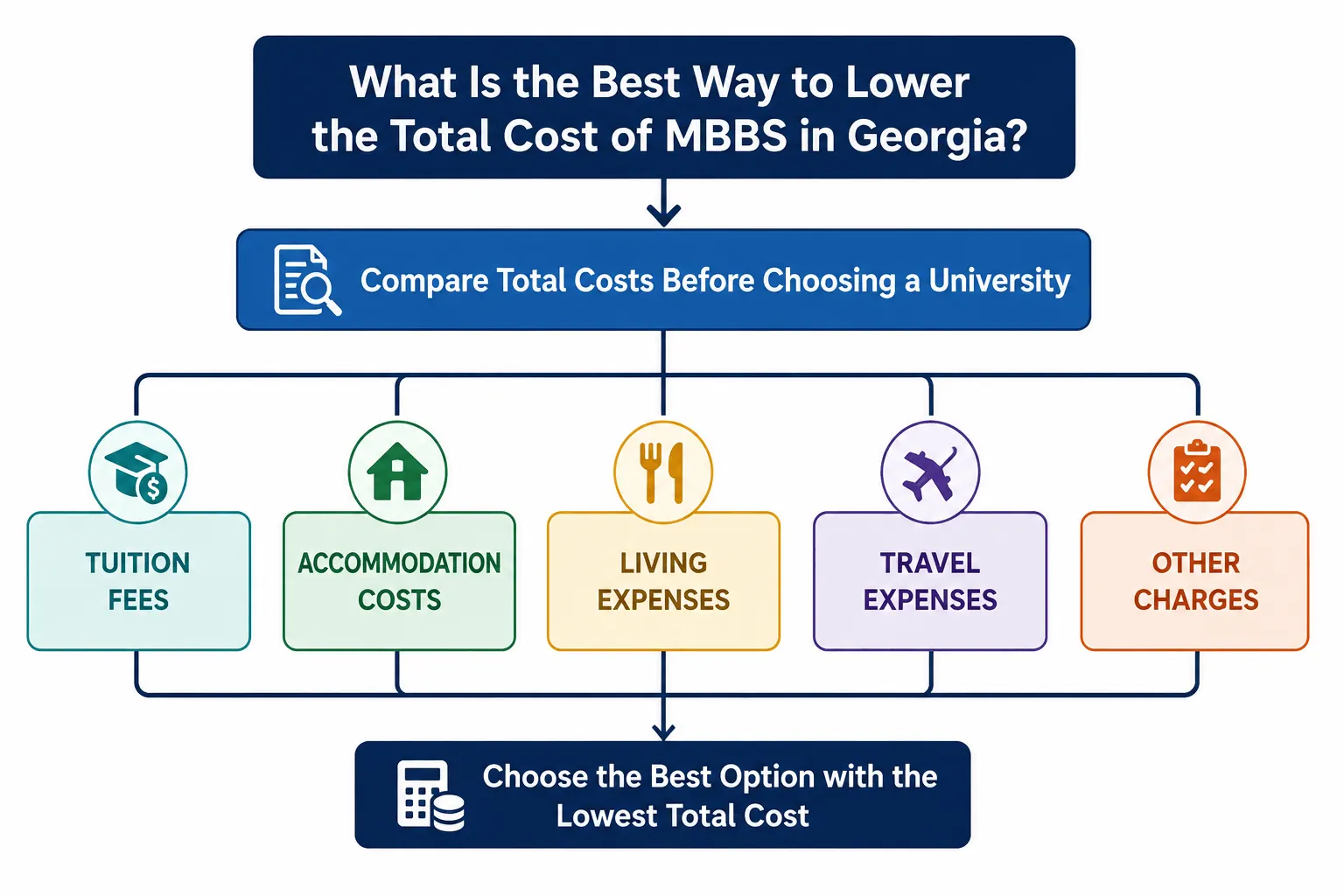
The living cost for Indian students in Georgia generally ranges from INR 20,000 to INR 45,000 per month ($240–$550), depending on the city, accommodation, and lifestyle. Students who want to pursue MBBS in Georgia can manage their expenses by choosing shared accommodation, cooking at home, using public transport, and planning their monthly budget carefully.
Tbilisi, Georgia's capital and a major student hub, can cost more than smaller cities such as Batumi, particularly for accommodation. Your actual monthly spending will depend on where you live and how you manage daily expenses.
| Expense | Estimated Monthly Cost |
|---|---|
| Accommodation | INR 6,500– INR 25,000 |
| Food & Groceries | INR 8,000– INR 15,000 |
| Local Transportation | INR 800– INR 3,000 |
| Utilities & Internet | INR 2,000– INR 5,000 |
| Miscellaneous Expenses | INR 3,000– INR 8,000 |
| Estimated Total | INR 20,000–INR 45,000 |
Accommodation can cost around INR 6,500– INR 25,000 per month, depending on whether you choose a university hostel, shared apartment, or private accommodation.
Students who wish to study MBBS in Georgia can share an apartment to reduce their rent and utility costs. However, students who choose private housing in central Tbilisi may spend more.
Before choosing accommodation, compare the monthly rent, utility charges, distance from the university, and transportation costs. A cheaper apartment far from campus can increase your monthly travel expenses.
Food and groceries can cost approximately INR 8,000– INR 15,000 per month. Students who cook at home can manage their food budget more effectively.
Indian students aspiring for MBBS in Georgia can also find Indian restaurants, grocery stores, and mess options in major student areas. However, eating outside regularly can increase your monthly spending.
Local transportation can cost around INR 800– INR 3,000 per month. Students who want to study MBBS in Georgia can use public buses and the metro in Tbilisi for regular travel.
Your transportation budget will depend on your accommodation and how frequently you travel around the city.
Students who rent apartments should budget approximately INR 2,000– INR 5,000 per month for utilities and internet.
This can include:
Always ask your landlord or accommodation provider which utilities the rent includes.
Keep around INR 3,000 to INR 8,000 per month for personal and leisure expenses. This budget can cover items such as:
MBBS in Georgia and MBBS in Russia can both be options for Indian students, but the better choice depends on your budget, preferred language of study, university, clinical training, and plans after graduation. Georgia has a strong selection of English-taught medical programs, while Russia offers a much larger network of established medical universities and may suit students looking for a wider range of institutions.
Here is a detailed comparison of MBBS in Georgia vs MBBS in Russia:
| Factor | MBBS in Georgia | MBBS in Russia |
|---|---|---|
| Medium of instruction | Many medical programs are available in English. | English-taught programs are available, but Russian can become important for communication during clinical training. |
| Course duration | Generally around 6 years, depending on the university and program. | Generally around 6 years, depending on the university and program. |
| Tuition fees | Vary by university. Official listings currently show several English medical programs from about USD 4,000 to USD 8,000 per year, with some programs costing more. | Vary substantially by university and city, with some institutions offering comparatively lower tuition. |
| University options | Multiple universities offer English-taught Medical Doctor or Medicine programs. | Offers a large network of established medical universities across different regions. |
| Academic approach | Medical programs follow Georgia's higher-education framework and are offered as one-step medical education programs. | Many universities have long-established medical education and research systems. |
| Clinical training | Depends on the university, curriculum, affiliated hospitals, and clinical arrangements. | Varies by university, hospital network, city, and program. |
| Language during clinical exposure | English can support academic learning, but basic Georgian may help with local patient communication. | Russian can be particularly useful when communicating with local patients. |
| Student environment | Compact study destinations such as Tbilisi and Batumi offer international student communities. | Student experience varies considerably by city and university. |
| Best suited for | Students who prioritize English-taught medical education and a relatively compact European study environment. | Students who want a broader choice of established medical universities and are willing to consider differences in language and location. |
After completing MBBS in Georgia, graduates can pursue medical practice, residency, postgraduate education, research, or healthcare-related careers, depending on the country where they plan to work. For Indian students, returning to India requires meeting the applicable NMC rules and completing the required licensing process before practising medicine.
Here are the main career options after MBBS in Georgia:
Indian graduates can return to India after completing MBBS in Georgia and pursue medical registration after fulfilling the applicable requirements for foreign medical graduates. The NMC’s Information for Students to Study Abroad states that Indian citizens and OCI cardholders who obtain primary medical qualifications outside India must meet the prescribed eligibility and licensing requirements for registration in India.
Therefore, students planning to build their career in India after doing MBBS in Georgia should understand the current NMC regulations before selecting a Georgia medical university.
MBBS in Georgia graduates can explore postgraduate medical training in Georgia if they meet the country's admission and professional licensing requirements. Residency options depend on the medical specialty, institution, available positions, and current regulations.
Students interested in this route should check the eligibility requirements of individual residency programs before completing their MBBS in Georgia.
A Georgian medical degree can also be part of a broader international medical career plan. MBBS in Georgia graduates may apply for postgraduate training in countries such as the UK, USA, Australia, or other destinations.
However, each country has its own licensing examinations, credential verification, language requirements, and registration process. A medical degree from Georgia does not automatically provide a licence to practise medicine in another country.
Students who enjoy medical science and academic work can move into medical research after completing their MBBS in Georgia. Options may include clinical research, laboratory research, public health research, or further academic study.
A postgraduate qualification can strengthen opportunities in universities, research institutions, hospitals, and healthcare organizations.
Not every student chooses direct patient care after completing MBBS in Georgia. Depending on their qualifications and local regulations, graduates can explore areas such as:
These roles may have different eligibility requirements from those required for clinical practice.
Read More: After MBBS in Georgia | Career Scope, Validity & Opportunities
When choosing MBBS in Georgia, Indian students can put their medical careers at risk by overlooking NMC guidelines, relying on unverified agents, or failing to assess hidden costs and clinical training quality. Thorough research into university recognition, eligibility requirements, academic outcomes, clinical exposure, and living costs can help students avoid serious financial and academic setbacks when choosing MBBS in Georgia.
Here are the common mistakes to avoid when choosing MBBS in Georgia:
Do not assume that every Georgia medical university is automatically suitable for Indian students. Verify the specific institution and medical program against the latest requirements applicable to foreign medical graduates.
Also avoid treating a WDOMS listing as an accreditation or endorsement. WDOMS itself states that listing does not mean a school is recognized or accredited. For Indian students, the NMC's current regulations and guidance should be part of your university-selection process for pursuing MBBS in Georgia.
Indian students should not assume that they can study MBBS in Georgia without meeting India's applicable NEET requirements. If your goal is to pursue medical practice in India after completing MBBS in Georgia, verify the current NEET and foreign medical graduate requirements before admission.
Do not rely on an agent's promise that a particular admission route will allow you to bypass Indian eligibility requirements.
Various Georgia medical universities commonly award a Doctor of Medicine (MD) degree for their undergraduate medical program. The difference in degree nomenclature does not, by itself, determine whether an Indian graduate can practice medicine in India.
What matters is whether your education and subsequent licensing pathway satisfy the applicable Indian regulations. Confirm the current requirements instead of judging an MBBS in Georgia program only by the name printed on the degree.
A low tuition quote does not necessarily mean a lower overall MBBS in Georgia cost.
Before comparing Georgia MBBS fees, calculate the complete budget, including:
Ask the university for a written fee structure and clarify whether tuition fees can change in later years.
Do not choose a university based solely on an education agent's claims. Be cautious about advertisements promising exceptionally low Georgia MBBS fees, guaranteed admission, guaranteed visas, guaranteed licensing-exam results, or "NMC-approved" universities.
Verify important information directly with the university and relevant authorities. Keep copies of the official admission letter, fee structure, payment instructions, and other documents provided to you for the MBBS admission in Georgia.
Strong clinical training matters as much as classroom education when you study MBBS in Georgia.
Before selecting a university, ask:
Do not choose an MBBS in Georgia program simply because it has modern classrooms or attractive campus facilities. Practical exposure should form a major part of your comparison.
Many MBBS in Georgia programs for international students use English as the teaching language, but clinical communication can be different from classroom learning.
Students may need to communicate with local patients and healthcare staff during hospital training of their MBBS in Georgia program. Ask the university what language students use during clinical rotations and whether it provides local-language instruction. Learning basic Georgian early can make everyday communication and clinical interactions easier.
Yes, a Medical Doctor (MD) qualification (equivalent to MBBS in Georgia) from Georgia can be considered for medical registration in India, provided the specific medical program and the graduate meet the applicable National Medical Commission (NMC) requirements.
For MBBS in Georgia for Indian students, recognition depends on the specific medical university and program, including factors such as course duration, medium of instruction, curriculum, clinical training, internship arrangements, foreign registration, and other requirements prescribed by the NMC. The NMC has specifically advised students planning to study medicine abroad to verify these conditions before admission because non-compliance can affect eligibility for registration in India.
Therefore, before taking MBBS admission in Georgia, students should verify:
The NMC's Foreign Medical Graduate Licentiate Regulations, 2021 prescribe requirements concerning the duration of foreign medical education, English-medium instruction, mandatory subjects, clinical training, internship, foreign registration, and the examination or licensing requirements applicable to foreign medical graduates.
Students should also avoid treating a listing in the World Directory of Medical Schools (WDOMS) as a substitute for checking NMC requirements. WDOMS status and eligibility for medical registration in India are separate considerations.
Choosing a medical destination is not just about finding a low-cost degree; it is about finding the right balance of education, clinical exposure, affordability, and long-term career prospects. MBBS in Georgia can be an attractive option for Indian students seeking English-medium medical education and an international academic environment.
However, the right university matters. Compare Georgia MBBS fees, curriculum, clinical training, university recognition, accommodation, and total living costs before making your decision. Most importantly, understand the eligibility and regulatory requirements before starting your MBBS admission in Georgia.
A smart decision today can shape your medical career for years to come. Research your options, verify every detail, and choose a Georgia medical university that fits your academic and career goals.

Author Email: studytutelage@gmail.com Contact Number: +91-9667 667 331

Hey I am Nafisa Khan. I am sharing my own experience with Tutelage study it was really good. They supported me in all the ways I was having so many doubts and my family was too confused about my safety and my admission but the team completely supported us and still they are supporting me whenever I face any problem here in Alte University, Georgia. My Consultant was Ms. Anitha and she’s been absolutely wonderful and helpful with managing and making me achieve what I wanted. I didn't even spend a single penny from application to visa and it’s safe to say that this consultancy isn’t a money monger and won’t ask for money until necessary. All of my visa stuff was handled by the Team who also were super accommodating and efficient with their work. I’m glad that I had them as my consultancy because they’re very determined and professional. Thank you !✨


