
With NEET becoming increasingly competitive and the cost of private colleges rising, Indian students are now pursuing MBBS in Kazakhstan as a practical and economical alternative. The cost of full medical education in Kazakhstan is around Rs. 20–35 lakhs, almost half the fees for private MBBS medical colleges in India, where costs can exceed Rs. 1 crore.
To put it simply, MBBS in Kazakhstan is a 5–6 year program in English medium with PCB in 12th and qualifying NEET as the main eligibility criteria. Low cost, international experience, and relative ease of admission, all in all, make Kazakhstan one of the fastest-growing markets for Indian medical aspirants.
In this post, you will find the complete MBBS in Kazakhstan fees structure, top medical universities in Kazakhstan, eligibility, admission procedure, and everything that a student should know before applying.
The MBBS in Kazakhstan (commonly awarded as an MD Physician equivalent degree) is a 6-year-long program, designed to impart strong theoretical knowledge alongside intense clinical practice. Consistent with international standards and the recommendations of the National Medical Commission (NMC) for students who wish to practice in India, the program comprises 5 academic years and 1 compulsory internship year.
Phases of the MBBS Curriculum in Kazakhstan
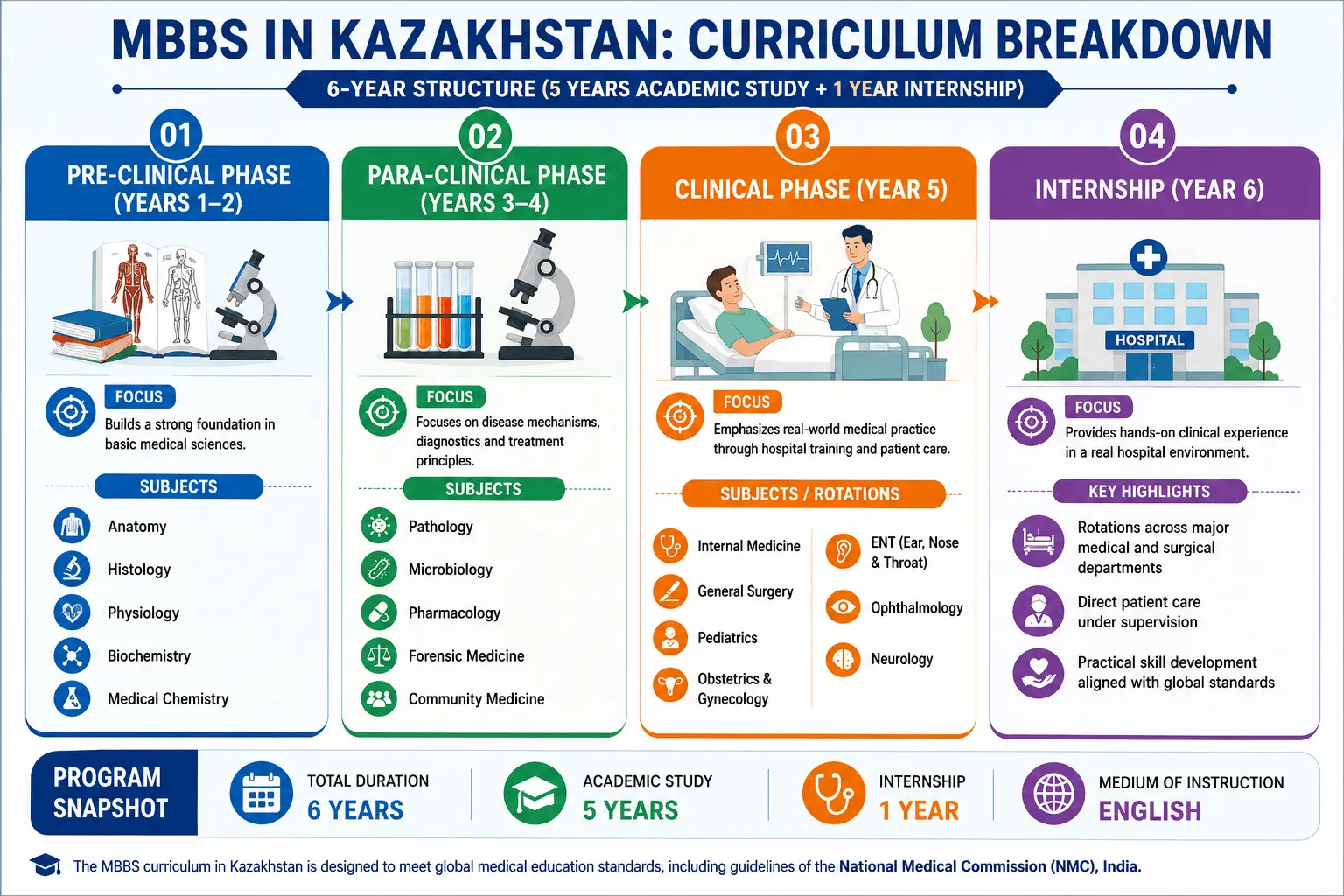
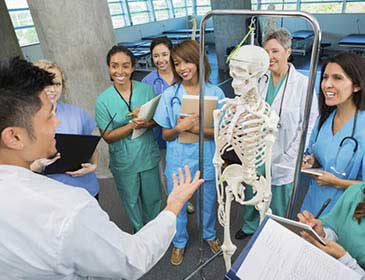
The pre-clinical phase of MBBS in Kazakhstan is considered the foundation of medical training that focuses on fundamental subjects needed for students to comprehend normal structures and functions of the human body. For the first few years, the focus is on developing solid theoretical knowledge, a crucial step prior to training in pathology and clinical studies.
Students learn body organization at both the macroscopic and microscopic levels, and the coordinated functions of various systems. Anatomy, for instance, describes the shape of organs and systems; physiology familiarizes students with how these systems function under real-life conditions. Biochemistry and medical chemistry augment this understanding by describing the chemical processes of life and living.
Key subjects include:
The para-clinical phase of MBBS in Kazakhstan is the moment where a shift from understanding basic sciences to concepts of disease, diagnosis, and treatment occurs. At this stage, students start to integrate their theoretical knowledge with clinical practice, preparing them to accurately diagnose and manage patients.
This stage also focuses on disease mechanisms (pathogenesis), laboratory investigations, and pharmacological interventions, helping students learn how illnesses develop, how they are detected, and how they are treated. It also introduces students to concepts like public health and the law surrounding medical practice, which are important to responsible clinical decisions.
Key subjects include:
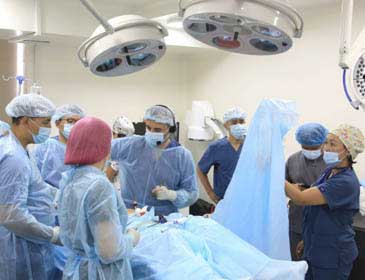
Students in the clinical phase move from classes to actual medical practice. Supervised by skilled physicians, these students go on rounds with patients, discuss cases, and perform basic procedures, which greatly adds to their experience.
This stage emphasizes clinical reasoning, diagnosis, and patient management. The students rotate through departments at all affiliated hospitals and gain experience with a wide range of illnesses and treatments. Thus, students attending a medical university in Kazakhstan benefit from this practical experience as it prepares them for actual medical situations as well as their upcoming licensing exams.
Key subjects and rotations include:
The last phase of the MBBS in Kazakhstan is a compulsory year-long, rotating internship in university hospitals. This period is particularly important as it serves as a transition between studying medicine and practicing medicine alone. Students learn how to diagnose and manage patients in actual clinical settings with the supervision of seasoned physicians.
This internship is extremely important for developing clinical confidence as well as preparing for licensing exams, including FMGE/NExT, when it comes to pursuing MBBS in Kazakh for Indian students. It ensures that graduates are theoretically sound, but also have the practical competence to handle real medical situations.
Key highlights include:
The move toward MBBS in Kazakhstan is explicitly due to increasing NEET competition in India and the need for affordable, globally recognizable medical education.
As per official statistics: Indian Embassy found that more than 9500+ Indian students were already studying in Kazakhstan. Today, the number has increased to more than 10,000 Indian students studying MBBS in Kazakhstan.
Let’s discuss in detail the major reasons behind this paradigm shift among Indian students.
An important reason why students prefer doing MBBS in Kazakhstan is because of an affordable fee structure with no hidden costs. The total fees can cost a total of Rs. 20–35 lakhs, which is considerably cheaper than private medical colleges in India, where expensive fees can be upward of Rs. 1 crore.
There are also no donation charges, no capitation fees, and no hidden costs, which fosters trust among the students and parents. Cost of living is also manageable, being around Rs. 15,000-20,000 per month as well. For many Indian families, therefore, studying at a medical university in Kazakhstan makes good financial sense.
The simplicity and lack of a stressful admissions process for MBBS in Kazakhstan is another key reason for the growing numbers. Unlike the highly competitive Indian system, students only have to meet predetermined eligibility criteria, which in this case is only completion of 10+2 with Physics, Chemistry, and Biology and a qualifying NEET score.
No other entrance exam, IELTS, or language proficiency test is required, which makes it all easier. This feature simplifies the process for students to get into a Kazakhstan medical university, as there is no arduous admission process or cut-throat competition involved.
Academic Quality & Global Recognition
Kazakhstan’s MBBS degree is globally recognized along with quality education, which is why it is gaining popularity. The majority of medical universities in Kazakhstan are listed in the NMC, WHO, FAIMER, and other international organizations, granting students opportunities to work as medical practitioners across the globe.
Students are then eligible to appear for FMGE/NExT in India, USMLE in the United States, and PLAB in the United Kingdom. Renowned institutions such as Kazakh Medical University, Almaty and Kazakh National Medical University, Kazakhstan have organized curricula and clinical training that are consistent with international medical standards, which add to the validity of the degree.
One of the biggest benefits of pursuing MBBS in Kazakhstan is that nearly all universities offer MBBS in English. This completely removes any language barrier that Indian students might face in going to Kazakhstan for their medical education, as they will not need to know Kazakh or Russian beforehand.
Although local languages might be learned during clinical training in order to help patient interactions, academic education at a medical university in Kazakhstan is predominantly in English. This ensures clear learning and helps international students integrate more smoothly.
MBBS in Kazakhstan aims to provide theoretical knowledge along with practical exposure. It is a 6-year program, with one year of mandatory internship and 5 years of study.
Clinical experience often starts early, and clinical training is hospital-based from an early stage in the university’s curriculum. The affiliated hospitals provide an excellent opportunity for students to develop their clinical skills in diagnostics and patient care. This hands-on approach leaves graduates of a medical university in Kazakhstan ready to practice medicine in the real world.
Kazakhstan is a friendly and student-accommodating country, where Indian students find it relatively easy to adapt. Indian student populations are increasing in cities like Almaty and Astana, which decreases cultural barriers.
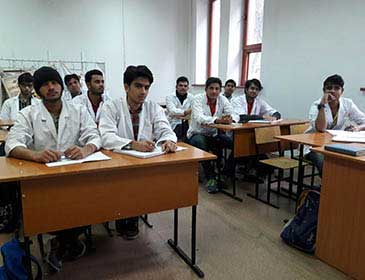
There is availability of hostels, Indian food, and a peer support network for those studying MBBS in Kazakhstan. The overall environment is safe, structured, and conducive to focused academic learning, ensuring a comfortable stay and learning through the academic course duration.
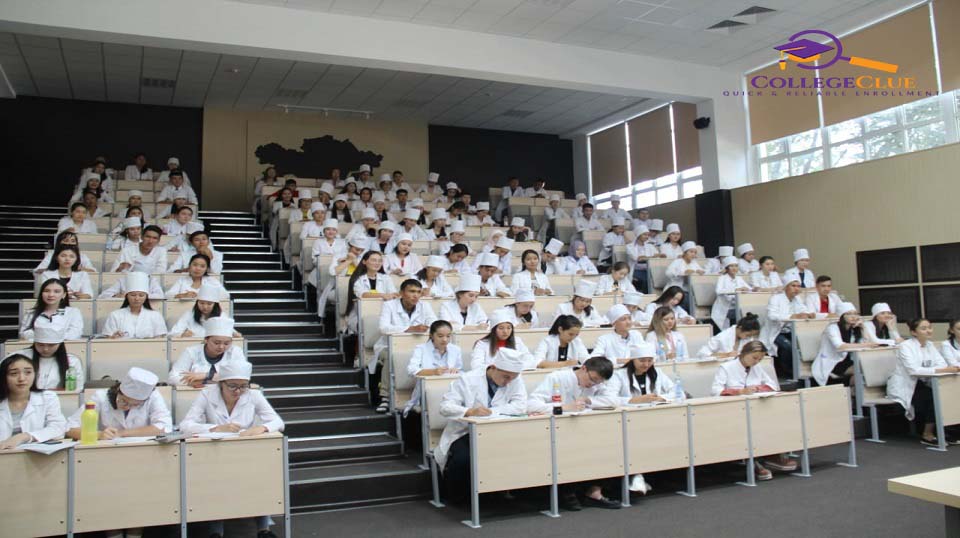
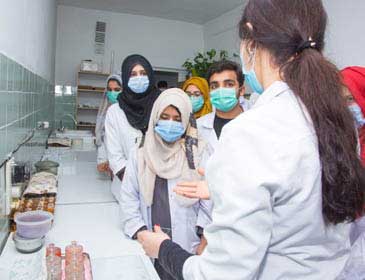
Kazakhstan medical universities have modern infrastructure that supports the learning process. Institutions have newer laboratories and simulation centers, and strong hospital affiliations that provide quality clinical training.
Universities like Kazakh National Medical University, Kazakhstan provide access to newer medical equipment and structured clinical rotations that assist in developing students’ practical skills. Offering around 10 medical universities, MBBS in Kazakhstan facilitates plenty of choice with a relatively wide range of internationally compatible facilities and resources.
To secure admission to MBBS in Kazakhstan, students must meet a clear set of academic, age, and NEET requirements defined by international standards and NMC regulations.
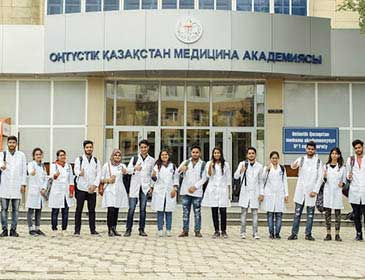
Institutions like Kazakh National Medical University, Astana Medical University, and Al-Farabi Kazakh National University consistently rank among the best due to their strong reputation, modern infrastructure, English-medium programs, and extensive hospital affiliations for practical exposure.
We have selected the following 6 universities because they provide the best mix of quality education, international accreditation by WHO and NMC, experienced faculty, and affordable Kazakhstan fees.
| University Name | Asfendiyarov Kazakh National Medical University (KazNMU) |
|---|---|
| Established | 1934 |
| Location | Almaty, Kazakhstan |
| Accreditation | WHO, NMC (India), UNESCO, globally recognized |
| Medium of Instruction | English |
| Course Duration | 6 Years (5 Years Academic + 1 Year Internship) |
| Annual Tuition Fees | $4000 - $6500 |
| Hostel Fees | Approx. $500 – $1,000 per year |
| Eligibility | 50% in PCB + NEET Qualification + Minimum Age 17 |
| University Name | Astana Medical University (AMU) |
|---|---|
| Established | 1964 |
| Location | Astana (Nur-Sultan), Kazakhstan |
| Accreditation | WHO, NMC (India), internationally recognized |
| Medium of Instruction | English |
| Course Duration | 5 Years + 1 Year Internship |
| Annual Tuition Fees | Approx. $4,000 – $6,500 per year |
| Hostel Fees | Approx. $600 – $800 per year |
| Eligibility | 50% in PCB + NEET Qualification |
| University Name | West Kazakhstan Marat Medical University |
|---|---|
| Established | 1957 |
| Location | Aktobe, Kazakhstan |
| Accreditation | Recognized by WHO, NMC (India), and other global medical bodies |
| Medium of Instruction | English |
| Course Duration | 5 Years + 1 Year Internship |
| Annual Tuition Fees | Approx. $3,500 – $4,800 per year |
| Hostel Fees | Approx. $500 – $600 per year |
| Eligibility | 50% in PCB + NEET Qualification |
| University Name | North Kazakhstan State University |
|---|---|
| Established | 1937 |
| Location | Petropavi, Kazakhstan |
| Accreditation | Recognized public university; listed in global academic frameworks and medical directories |
| Medium of Instruction | English |
| Course Duration | 5 Years + 1 Year Internship |
| Annual Tuition Fees | Approx. $3,900 per year |
| Hostel Fees | Approx. $500 – $900 per year |
| Eligibility | 50% in PCB + NEET Qualification |
| University Name | Al-Farabi Kazakh National University |
|---|---|
| Established | 1930 |
| Location | Almaty, Kazakhstan |
| Accreditation | WHO, NMC (India), globally recognised |
| Medium of Instruction | English |
| Course Duration | 5 Years + 1 Year Internship |
| Annual Tuition Fees | Approx. $3,500 – $5,400 per year |
| Hostel Fees | Approx. $500 – $1,000 per year |
| Eligibility | 50% in PCB + NEET Qualification |
| University Name | South Kazakhstan Medical Academy |
|---|---|
| Established | 1979 |
| Location | Shymkent, Kazakhstan |
| Accreditation | WHO, NMC (India) |
| Medium of Instruction | English |
| Course Duration | 5 Years + 1 Year Internship |
| Annual Tuition Fees | Approx. $3,500 – $4,500 per year |
| Hostel Fees | Approx. $400 – $700 per year |
| Eligibility | 50% in PCB + NEET Qualification |
| University Name | Kazakh Russian Medical University |
|---|---|
| Established | 1991 |
| Location | Almaty, Kazakhstan |
| Accreditation | WHO, NMC (India) |
| Medium of Instruction | English |
| Course Duration | 5 Years + 1 Year Internship |
| Annual Tuition Fees | Approx. $3,500 – $4,500 per year |
| Hostel Fees | Approx. $500 – $900 per year |
| Eligibility | 50% in PCB + NEET Qualification |
| University Name | Semey Medical University |
|---|---|
| Established | 1953 |
| Location | Semey, Kazakhstan |
| Accreditation | WHO, NMC (India) |
| Medium of Instruction | English |
| Course Duration | 5 Years + 1 Year Internship |
| Annual Tuition Fees | Approx. $3,500 – $3,800 per year |
| Hostel Fees | Approx. $500 – $900 per year |
| Eligibility | 50% in PCB + NEET Qualification |
| University Name | Caspian International School of Medicine |
|---|---|
| Established | 1992 |
| Location | Almaty, Kazakhstan |
| Accreditation | WHO, NMC (India) |
| Medium of Instruction | English |
| Course Duration | 5 Years + 1 Year Internship |
| Annual Tuition Fees | Approx. $4,500 per year |
| Hostel Fees | Approx. $600 – $1,200 per year |
| Eligibility | 50% in PCB + NEET Qualification |
| University Name | Karaganda Medical University |
|---|---|
| Established | 1950 |
| Location | Almaty, Kazakhstan |
| Accreditation | Recognized by the Ministry of Education of Kazakhstan; listed in global medical directories |
| Medium of Instruction | English |
| Course Duration | 5 Years + 1 Year Internship |
| Annual Tuition Fees | Approx. $4,000 – $5,000 per year |
| Hostel Fees | Approx. $500 – $1,000 per year |
| Eligibility | 50% in PCB + NEET Qualification |
| University Name | Kokshetau State University |
|---|---|
| Established | 1962 |
| Location | Kokshetau, Kazakhstan |
| Accreditation | WHO, NMC (India) |
| Medium of Instruction | English |
| Course Duration | 5 Years + 1 Year Internship |
| Annual Tuition Fees | Approx. $3,800 per year |
| Hostel Fees | Approx. $800 per year |
| Eligibility | 50% in PCB + NEET Qualification |
When choosing a medical university in Kazakhstan, fee structure cannot be the only criterion; global recognition, clinical exposure, FMGE/NExT performance, infrastructure and quality of education are equally important.
Here are the key factors to consider when selecting the right medical university in Kazakhstan:
NMC & Global Recognition: Always take admission in an NMC-approved university and also recognized by world bodies like WHO. This is necessary to practice in India and to sit for FMGE/NExT, USMLE, and PLAB examinations.
Pro Tip: Pick the university that has the best combination of quality academics and clinical training, and not just the lowest cost. A diverse university will prepare you better for international medicine.
The total cost for MBBS in Kazakhstan typically ranges between Rs. 20 Lakhs to Rs. 36 Lakhs for the full 6-year course, including tuition, hostel, and basic living expenses.
| Expense Type | Estimated Cost |
|---|---|
| Total Course Cost (6 Years) | ?20 Lakhs – ?36 Lakhs |
| Annual Tuition Fees | $3,000 – $6,000 (?2.5L – ?5L) |
| Monthly Living Cost | $300 – $500 (?25,000 – ?40,000) |
| One-Time Initial Cost | ?50,000 – ?1,00,000 |
| Category | Cost (USD) | Cost (INR Approx.) |
|---|---|---|
| Tuition Fees | $3,000 – $6,000 per year | ?2.5L – ?5L |
| Hostel & Accommodation | $200 – $300/month | ?60,000 – ?1,00,000/year |
| Food / Indian Mess | $100 – $150/month | ?1L – ?1.5L/year |
| Miscellaneous Expenses | $50 – $100/month | ?40,000 – ?80,000/year |
| Expense | Estimated Cost |
|---|---|
| Visa & Documentation | ?20,000 – ?40,000 |
| University Registration | ?20,000 – ?50,000 |
| Medical Insurance & Other Charges | ?10,000 – ?20,000 |
| Total One-Time Cost | ?50,000 – ?1,00,000 |
| University Name | Total Fees (USD) | Total Fees (INR Approx.) |
|---|---|---|
| Al-Farabi Kazakh National University (Almaty) | $37,200 – $40,000 | ?30L – ?33L |
| Astana Medical University (Astana) | ~$37,200 | ?30L – ?32L |
| Kazakh National Medical University (Almaty) | ~$40,800 | ?33L – ?36L |
| Semey Medical University (Semey) | ~$31,200 | ?25L – ?28L |
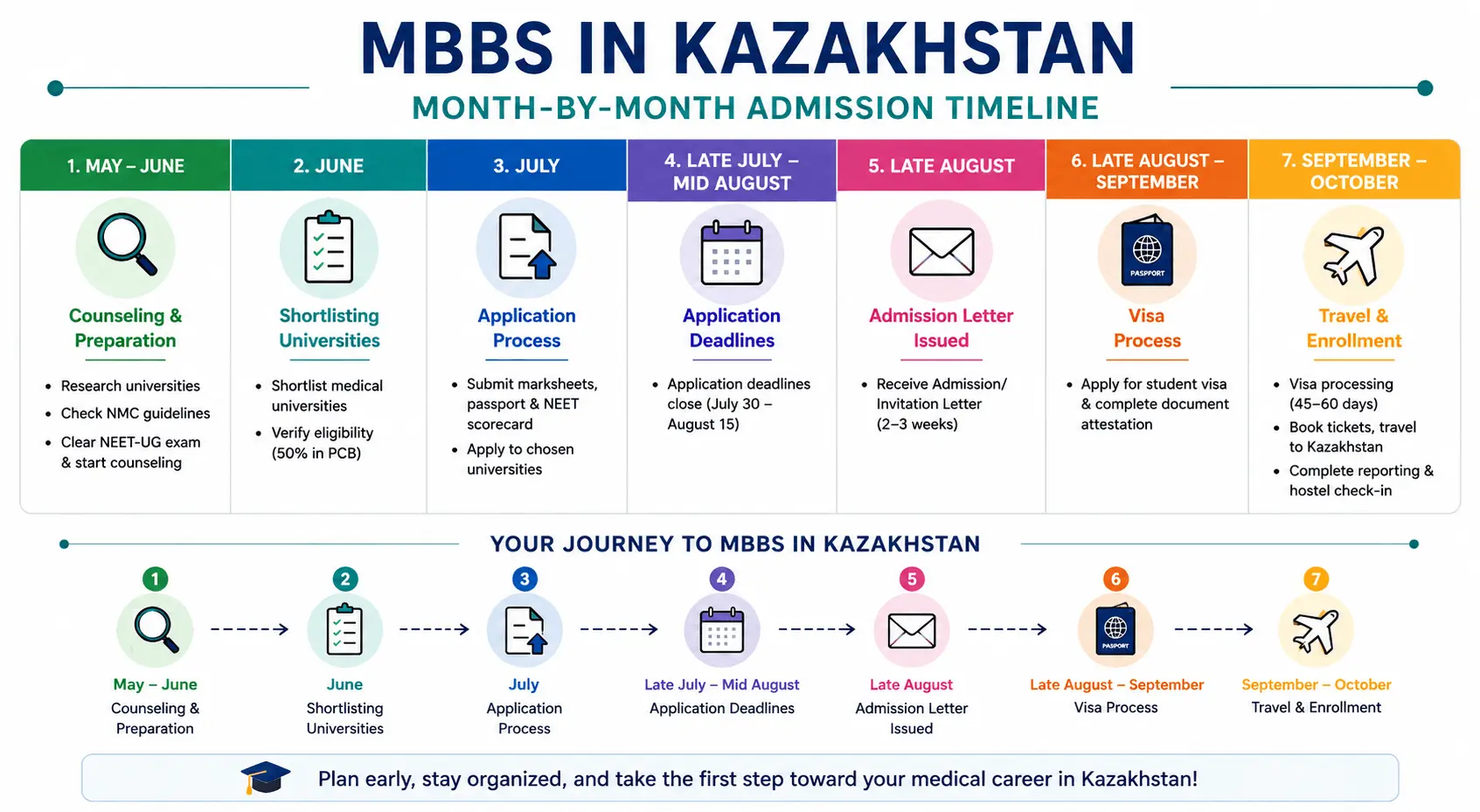
The admission process for MBBS in Kazakhstan for Indian students is completely transparent and follows NMC guidelines. Here’s a step-by-step process for taking admission in an MBBS course in any medical university in Kazakhstan.
The first step for students is to select a medical university in Kazakhstan that is recognized by the NMC and also by the WHO.
Choosing a good university must guarantee international recognition, a good educational level, and eligibility for the licensing exams. If students research infrastructure, faculty, and Kazakhstan fees, they are well prepared before applying.
Students then apply to the university of their choice by sending a scanned copy of the application documents. Medical schools in Kazakhstan that offer an MBBS program generally have a straightforward online application process. Students should make sure that all documents are clear and correct to avoid delays in admission confirmation.
After the review process of the application is complete, an official admission/invitation letter is issued from the chosen Kazakhstan medical university. This typically takes place over a period of 2 to 4 weeks.
The student’s confirmation of seat in the MBBS program will be as per this admission letter, which is also one of the important documents for completing the subsequent visa application process and admission/enrollment stages.
Once students have received the admission letter, they need to apply for the Kazakhstan student visa. The documents needed for the visa application include documents such as passport, admission letter, medical documents, and proof of funding.
Knowing the MBBS fees in Kazakhstan for Indian students also helps to prepare financial documentation. The visa is processed by the Kazakhstan embassy, and then students can legally travel to study.
Students must then book their travel to Kazakhstan once the visa is approved. When they arrive, they finalize enrollment at the university, deliver all original documentation, and pay their first year’s worth of tuition fees. The process now accepts the student into the MBBS in Kazakhstan program, thus commencing their medical education.
Here’s a month-by-month breakdown to help you stay organized and avoid last-minute delays:
| Category | Details |
|---|---|
| Capital | Astana |
| Population | 20 Million+ |
| Languages | Kazakh, Russian (English in medical programmes) |
| Currency | KZT |
| Location | Central Asia, bordering Russia and China |
| Timezone | UTC+5 |
| Independence | 16 December 1991 |
| Highest Peak | Khan Tengri (7,010 m) |
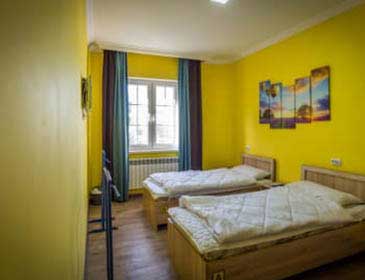
The cost of living in Kazakhstan is pretty low for Indian students as compared to countries such as the USA or UK. Accommodations are typically provided by the universities in the form of comfortable hostels, which drastically decreases costs. These hostels are furnished with beds and study tables, and are equipped with heating and internet, making for a comfortable lifestyle as a student.
Dining is also relatively inexpensive. Dining costs can be easily accommodated in the general cost of living, which averages about Rs. 5,000 to Rs. 8,000 monthly. Since accommodation and food are cheap, students can complete MBBS in Kazakh without financial drain.
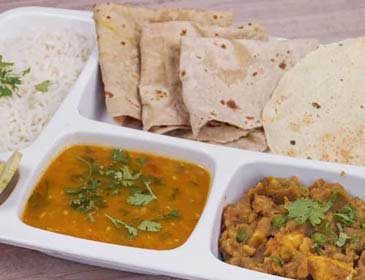
Most of the medical universities in Kazakhstan provide hostel amenities for international students on campus. Indian students in particular find the independent Indian messes very useful, as these provide a hygienic version of home food.
Major cities also have access to Indian community centers and Indian restaurants, as well as university mess facilities. Institutions like Kazakh Medical University, Almaty, and Kazakh National Medical University, Kazakhstan, facilitate this process by providing students with food and a hospitable living environment. This continuity of Indian communities provides students the opportunity to settle in and feel comfortable while studying abroad.
Kazakhstan has a continental climate, meaning students experience very cold winters and pleasant summers. In winter, temperatures can drop to -10 degrees Celsius or below, so adequate warm winter clothing is necessary.
Yet universities have centrally heated hostels that keep students indoors year-round. Also, the summers are lovely and pleasant. In general, the climate is not difficult to adjust to, and if adequate measures are taken, students can easily carry on with their academic and everyday lives.
The steps to get a student visa and travel to Kazakhstan for an MBBS course include receiving an invitation letter from the university, applying for a D category student visa at the embassy of Kazakhstan, and registering with the local migration office once the student has entered Kazakhstan.
Here’s the student visa application process for MBBS in Kazakhstan:
Students can apply for a student visa only after receiving their letter of admission from the university of their choice. This is an important requirement when applying for your Kazakhstan student visa.
Indian aspirants wishing to pursue their MBBS in Kazakhstan will need to apply for a long-term Category D Student Visa, which is granted specifically for international students studying in a medical university in Kazakhstan. You must obtain this visa to study and stay legally in the country for your course.
Students may now apply for their visas at the embassy or consulate of Kazakhstan in their home country. Universities will sometimes also help with visa letters to make it easier.
Students also need the following documents:
In some cases, applicants may be required to attend a visa interview. Students should be prepared to answer questions related to:
Providing honest and confident answers can help create a positive impression during the visa process.
On average, the Kazakhstan student visa process takes approximately 2-4 weeks based on document verification and embassy procedures. Students should double-check all visa information once their visa has been approved.
Once the visa is obtained, students can then prepare to go on begin their medical studies at Kazakh National Medical University, Kazakhstan, or any other university mentioned for MBBS.
Moving to a new country for medical education is in itself an exciting experience. If students plan ahead, they will have an easier time adjusting to the process.
An MBBS from Kazakhstan (equivalent to an MD degree) allows students to pursue various internationally recognized careers. Medical university graduates in Kazakhstan, once licensed, qualified, and skilled, are prepared to work clinically, attend graduate school, and engage in various aspects of the healthcare sector across the globe.
Among the most common pathways for Indian students doing MBBS in Kazakhstan is returning to India and practicing medicine.
Those who graduated from an accredited medical university in Kazakhstan can sit for licensing exams in other countries and pursue medical careers abroad.
Other Regions:
Besides working in medicine, MBBS graduates in Kazakhstan have a variety of options in the healthcare sector.
For aspiring doctors, picking the right medical school destination is a tough decision. MBBS in Kazakhstan is becoming a popular option for MBBS among international students due to the inexpensive cost of education, globally recognized universities, and a friendly atmosphere for students.
Let’s compare MBBS in Kazakhstan with other popular destinations:
| Factors | MBBS in Kazakhstan | MBBS in Russia | MBBS in China |
|---|---|---|---|
| Tuition Fees | $4,000 – $6,000 per year | $3,000 – $8,000 per year | $4,500 – $10,000 per year |
| Cost of Living | $150 – $300 per month | $200 – $400 per month | $250 – $500 per month |
| Language of Instruction | Mostly English-medium programs available | English & Russian-medium programs | English & Chinese-medium programs |
| Recognition & Accreditation | Recognized by WHO, NMC, ECFMG, and FAIMER-listed universities | Recognized by WHO, NMC, ECFMG, and FAIMER-listed universities | Recognized by WHO, NMC, ECFMG, and FAIMER-listed universities |
| Admission Process | Simple process; NEET qualification required for Indian students | Easy admission, but some universities may require entrance exams | More competitive admission; some universities may require HSK proficiency |
| Hostel & Accommodation | Affordable university dormitories with facilities for international students | University hostels and private accommodation options available | University hostels available, but private rentals can be expensive |
| FMGE/NExT Preparation | Supportive environment for Indian students preparing for licensing exams | Moderate preparation support; language can be a challenge | Requires additional focus due to language and academic differences |
| Clinical Exposure | Hands-on training through affiliated hospitals with international patient exposure | Good clinical training in university hospitals | Good clinical exposure, but local language may affect patient interaction |
| Climate | Moderate climate with cold winters; suitable for international students | Extremely cold winters in many regions | Varies from hot summers to cold winters depending on location |
| Safety & Student-Friendly Environment | Safe and welcoming environment with a growing Indian student community | Safe, but language barriers may affect daily communication | Safe, but students may need time to adjust to cultural differences |
| Opportunities After MBBS | Graduates can pursue licensing exams for India, USA, UK, and other countries | Globally recognized degree; Russian language skills help for local opportunities | Global opportunities available; local practice may require Chinese language proficiency |
| Best Suited For | Students seeking affordable education, English-medium programs, and international exposure | Students looking for established medical universities and diverse options | Students interested in advanced infrastructure and research opportunities |
Before confirming your admission, make sure you clearly understand the university's academic and financial policies.
Is the university registered under the new NMC regulations?
Ensure that the university adheres to the regulations of the National Medical Commission. This is important if you want to return to India and practice medicine after doing your MBBS in Kazakhstan.
Confirm whether the Kazakhstan fees for MBBS students mentioned cover only tuition fees or also include services such as labs, library access, insurance, and administrative fees.
Numerous universities do offer relatively low tuition, but have separate charges for room and board. Make sure to confirm the total annual fee to accurately calculate your cost of studying at a any Kazakhstan medical university.
Inquire about the clinical rotations, including where hospitals are and what type of patients you will be exposed to. One of the most important considerations when choosing a medical university in Kazakhstan is quality clinical training.
Look out for hidden costs that you may have to pay later, such as visa extension fees, medical insurance, exam fees, and administrative costs. Here, transparency is critical.
Check for services such as airport pickup, hostel help, visa renewal help, academic mentoring, and Indian food. Having a strong support system creates wonderful comfort in student life in Kazakhstan, especially for MBBS students from India.
A little research can help you avoid unreliable institutions and misleading admission offers.
Be cautious if:
There are many misconceptions among students and parents about pursuing MBBS in Kazakhstan. They create uncertainty regarding degree recognition, the quality of education, language requirements, and student life.
Let’s separate fact from common myth.
Myth 1: MBBS degrees from Kazakhstan are not recognized
Reality: The Kazakh National Medical University, Kazakhstan, and others are listed in the World Directory of Medical Schools and are recognized by world medical education advocacy organizations.
Myth 2: NEET is not required for Indian students
Reality: Students who wish to do MBBS in Kazakhstan must qualify NEET to apply for a medical license in India once they complete the degree.
Myth 3: The quality of medical education is low
Reality: Medical universities in Kazakhstan are well-established institutions that have structured medical curricula involving classes covering theoretical aspects, practical sessions, and clinical experience in affiliated hospitals.
Myth 4: Students must study only in Russian or Kazakh
Reality: There are numerous MBBS programs taught in English by universities in the country. There is no compulsion to learn Russian or Kazakh. However, learning basic Russian or Kazakh helps students communicate in their daily lives and during clinical training.
Myth 5: There are no career opportunities after MBBS in Kazakhstan
Reality: Apart from working in India through licensing exam FMGE/NExT, graduates can also attempt the USMLE and the PLAB/UKMLA to find opportunities abroad.
Myth 6: Living in Kazakhstan is unsafe for international students
Reality: Kazakhstan is a safe space for an international student, where universities and higher education institutions have their own hostels, security facilities, and support services for students.
Myth 7: Indian food is difficult to find in Kazakhstan
Reality: Indian food is served at many hostels and Indian restaurants/grocery stores are available in larger cities.
Myth 8: Studying MBBS in Kazakhstan is extremely expensive
Reality: The fees for MBBS as well as living expenses in Kazakhstan, compared to many private medical colleges abroad, are relatively economical, thus making it an affordable option for Indian students.
Myth 9: Students cannot adjust to the weather and lifestyle
Reality: Most international students adjust to life in Kazakhstan. They need to be prepared for the climate, sensitized to local culture, and engaged in campus life.
Myth 10: Only a few universities offer MBBS programs
Reality: There are around 10 well-known universities in Kazakhstan that offer medical degrees, such as Kazakh Medical University, Almaty.
Opting to study MBBS in Kazakhstan will not only give you a degree but also open up numerous opportunities. You can build a great medical career anywhere in the world with good universities, low cost of education, and strong clinical exposure.
The opportunities, in fact, are endless, from clearing licensing exams such as FMGE/NExT, practicing in countries such as the US or the UK, to even pursuing more exciting research and healthcare management careers.
The most important thing is to stay informed, ask the right questions, and make confident decisions at every step of the way, from choosing your university to applying for your Category D student visa.
Get personalized guidance for your MBBS in Kazakhstan admission journey:

Author Email: studytutelage@gmail.com Contact Number: +91-9667 667 331

This is really the perfect place if you are seeking guidance for higher studies abroad. The staff here are really friendly, especially my counselor Ms. Tanu. She has helped me in every step, from the beginning till I received my VISA. She answered my calls even during holidays, hence she has devoted a lot of her time and patience to me and has helped me to secure a seat for my master's at Al Farabi Kazakh National University, Kazakhstan. The support, guidance, and information that they provide have proven invaluable. I was recommended this institution by my relative, and with all the positive notes, without any doubt, I will recommend this to all.
I would like to Thank Tutelage Study for their immense support and help throughout my application process. They guided me right from the university selection, entire Astana Medical University, Kazakhstan univeristy application process and finally the visa application and visa counselling. They were always available for solving my queries and made sure all my doubts are being addressed satisfactory.. It was my best decision to go with Imperial.. Thanks a lot once again.. Kudos to the Team???????? Special Thanks to Tanu Madam