15 Aug, 2026, Ashish, Mbbs Abroad
| Factor | What Indian Students Should Know |
|---|---|
| Eligibility | Usually requires Class 12/equivalent with Physics, Chemistry and Biology/Biotechnology, subject to applicable rules |
| NEET | Indian students generally need to qualify NEET according to the rules applicable to their admission year if they intend to pursue medicine abroad and later seek registration in India |
| Course duration | Varies by country and university; NMC requirements must be checked for the applicable batch |
| Medium of instruction | English-medium requirements apply to FMGs covered by the relevant NMC regulations |
| Total cost | Varies substantially by country, university, city and lifestyle |
| Popular destinations | Russia, Kyrgyzstan, Uzbekistan, Kazakhstan, Georgia and others |
| Practice in India | Foreign medical graduates must satisfy the applicable Indian licensing and registration requirements |
| Biggest consideration | Do not choose a university based only on fees or popularity |
Studying MBBS abroad refers to pursuing a medicine degree at an approved foreign medical university instead of in India. In some countries, the medical degree bears a different name, for example, MD (Doctor of Medicine).
For students in India, having the MBBS overseas degree alone does not necessarily mean that one can practice medicine in India. The university, the course structure, clinical training, the internship, and relevant NMC requirements all make a difference.
Though the details vary from country to country, and from university to university, students can generally expect the following in an MBBS abroad:
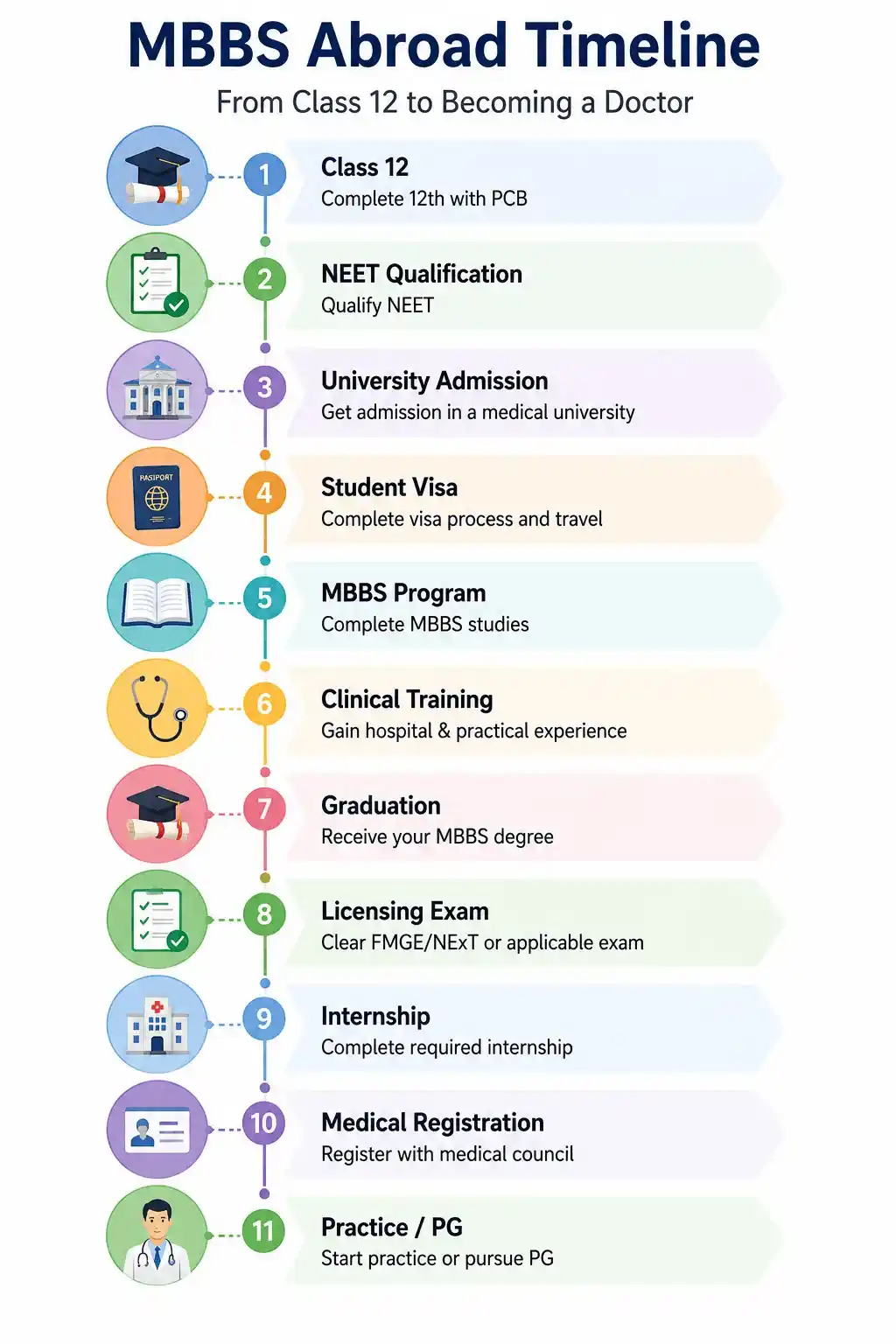
The timeline below covers the journey for Indian students who may return to India for medical practice as well as those who plan to pursue licensing and medical careers in foreign countries.
The exact steps, duration, examinations, internships, and registration requirements vary by destination country and the regulations applicable to your batch.
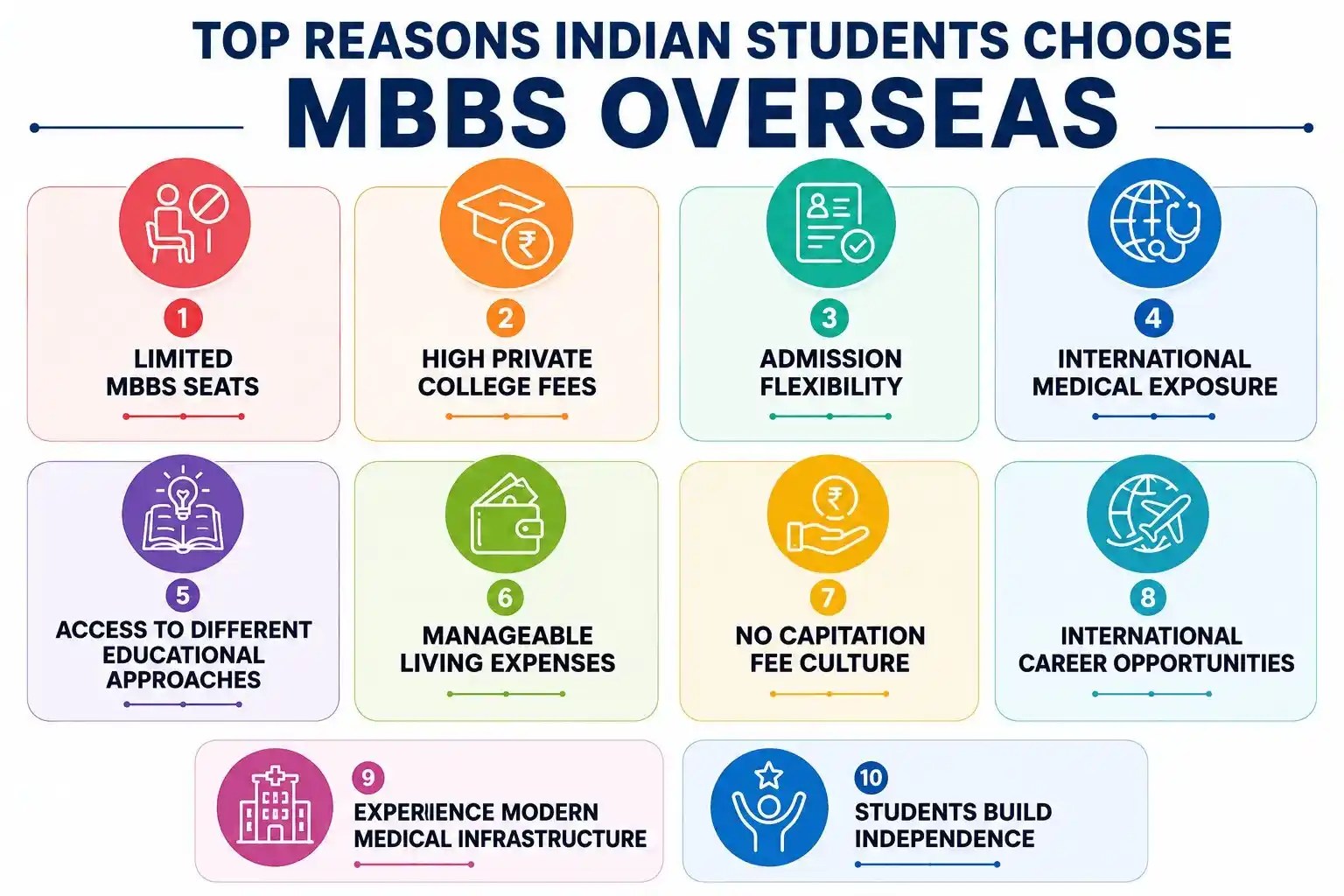
We have already discussed two key reasons why Indian students prefer MBBS abroad: limited MBBS seats and high private college fees.
But are seats and fees the only reasons for Indian students looking beyond India? Not exactly. There are also plenty of students who think of pursuing MBBS abroad due to the following reasons:
In India, there is a highly competitive medical-seat allocation system, which leaves many qualified students out. In NEET-UG 2026, over 23 lakh students gave the exam, and the NMC has around 1.30 lakh MBBS seats available in medical colleges across the country. This gives a sense of the size of the competition: roughly, there are 18 NEET candidates for each MBBS seat.
However, for MBBS overseas in foreign universities, students can apply directly after meeting their academic and regulatory requirements. They only need to pass the NEET exam and complete high school with the minimum required marks in science subjects. Additionally, admissions do not need high cut-offs like those needed for government seats in India. Due to all these factors, MBBS abroad offers more options instead of relying on limited seats available.
Note: MBBS abroad admission requirements vary from one country to another. Therefore, students should always verify the latest NMC requirements and university criteria before applying. You can also take the help of foreign educational consultants to navigate the process.
Pursuing an MBBS degree abroad can introduce students to varied healthcare systems, patient demographics, and clinical settings. They may also encounter different disease patterns, treatment approaches, and healthcare practices during their clinical training.
This experience can expose them to a healthcare system other than that in India. Also, working alongside students from different countries can further strengthen their communication, adaptability, and cross-cultural skills.
Countries vary in their approach to medical education. Some universities integrate classroom instruction with simulation, laboratory work, and clinical training in hospitals from the beginning of the training program. This variety of teaching approaches is one reason students consider MBBS abroad as an alternative to traditional medical education.
Medical laboratories and simulation centers can help prepare students to work with actual patients. Early exposure to patients may also bridge the theoretical concepts to practical medical application. For students pursuing MBBS overseas, this diversity can help students see how other healthcare systems train their future physicians.
Some popular MBBS abroad destinations offer relatively moderate costs for accommodation, food, transportation, and daily expenses. Students also have the option of shared accommodation and cheap meals to regulate their monthly expenditure.
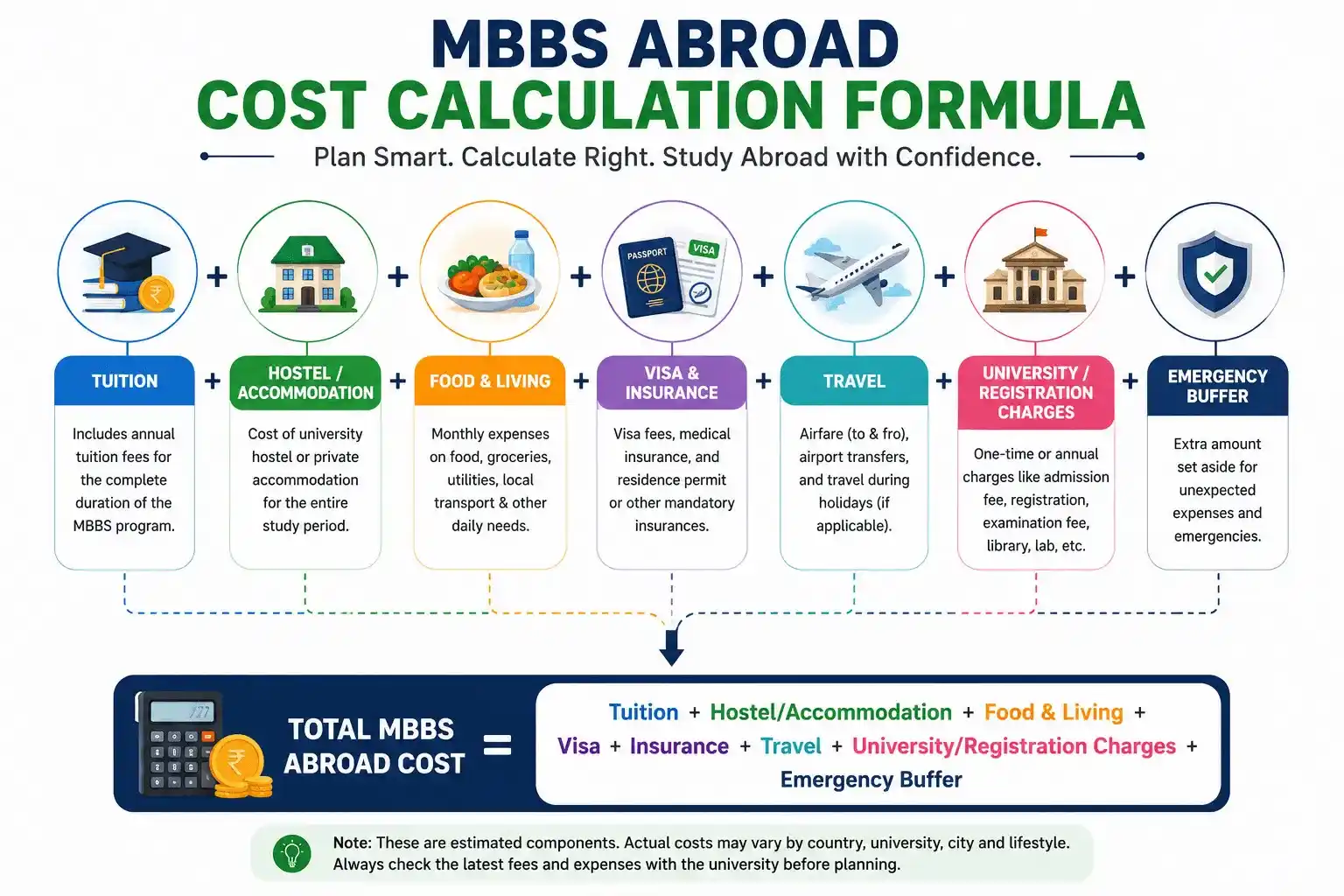
For Indian families, this can make overseas education easier to budget for, depending on the country and lifestyle. However, tuition fees, accommodation, food, travel, insurance, and other living expenses should be calculated together and finalized to prepare the complete MBBS abroad budget.
A report by Times of India, dated 2025 for Tamil Nadu, found that in certain self-financing medical colleges, extra amounts to be paid could reach up to a total of Rs. 12 lakh a year on top of the prescribed fee.
In one 2024 instance, a college that charged Rs. 4.35 lakh in announced first-year tuition also asked for Rs. 3.61 lakh more, bringing the reported total to Rs. 7.96 lakh. Another college that prescribed tuition of Rs. 4.45 lakh sought Rs. 4.15 lakh in other charges.
Unlike such private medical education sectors, most foreign universities have structured, published systems of tuition fees rather than capitation fees for admission. This can make MBBS abroad a more transparent option for students and parents when comparing the overall cost of medical education.
The tuition fees, hostel fees, registration fees and any other applicable fees are generally available for review to students before the actual process of admission commences. For students considering MBBS overseas, this can help families estimate their total expenses more clearly and avoid unexpected payment requests.
An MBBS at abroad can support future international careers. Depending on the country in which the MBBS is obtained, a degree from abroad can also open up international career options. Graduates have the option of attempting medical licensure exams, postgraduate education, research positions, or further medical training in countries like the UK, USA, Australia, or more.
But an MBBS degree abroad does not necessarily entitle one to practice in another country. Licensing exams, registration, and language and eligibility requirements vary by destination. Therefore, students should begin thinking about their long-term career plans only after choosing a university and country.
Some international medical universities have modern laboratories, simulation centers, teaching hospitals, and specialized clinical departments. These facilities can help students pursuing MBBS abroad connect classroom concepts with practical medical training.
Students pursuing MBBS overseas may gain exposure to clinical practice through simulated environments and laboratory sessions, where they can develop essential skills before working with real patients. Teaching hospitals also provide opportunities to observe different medical departments and understand how healthcare professionals interact with and care for patients.
Pursuing an MBBS degree abroad encompasses much more than classroom studies and clinical training. Students also learn to cope with housing, finances, transportation, education, and daily living away from home.
This experience can make students pursuing MBBS abroad more independent, flexible, and confident in dealing with and adapting to new situations. Living with students from other cultures can also improve communication and broaden their perspective. For many Indian students, pursuing MBBS overseas can help develop personal skills alongside their medical education and professional development.
Before applying for MBBS abroad, Indian students need to meet certain academic, age, and other requirements.
Common documents include:
Note: Eligibility requirements and documents can differ between universities for MBBS abroad, so students should always check the official websites for confirmation.
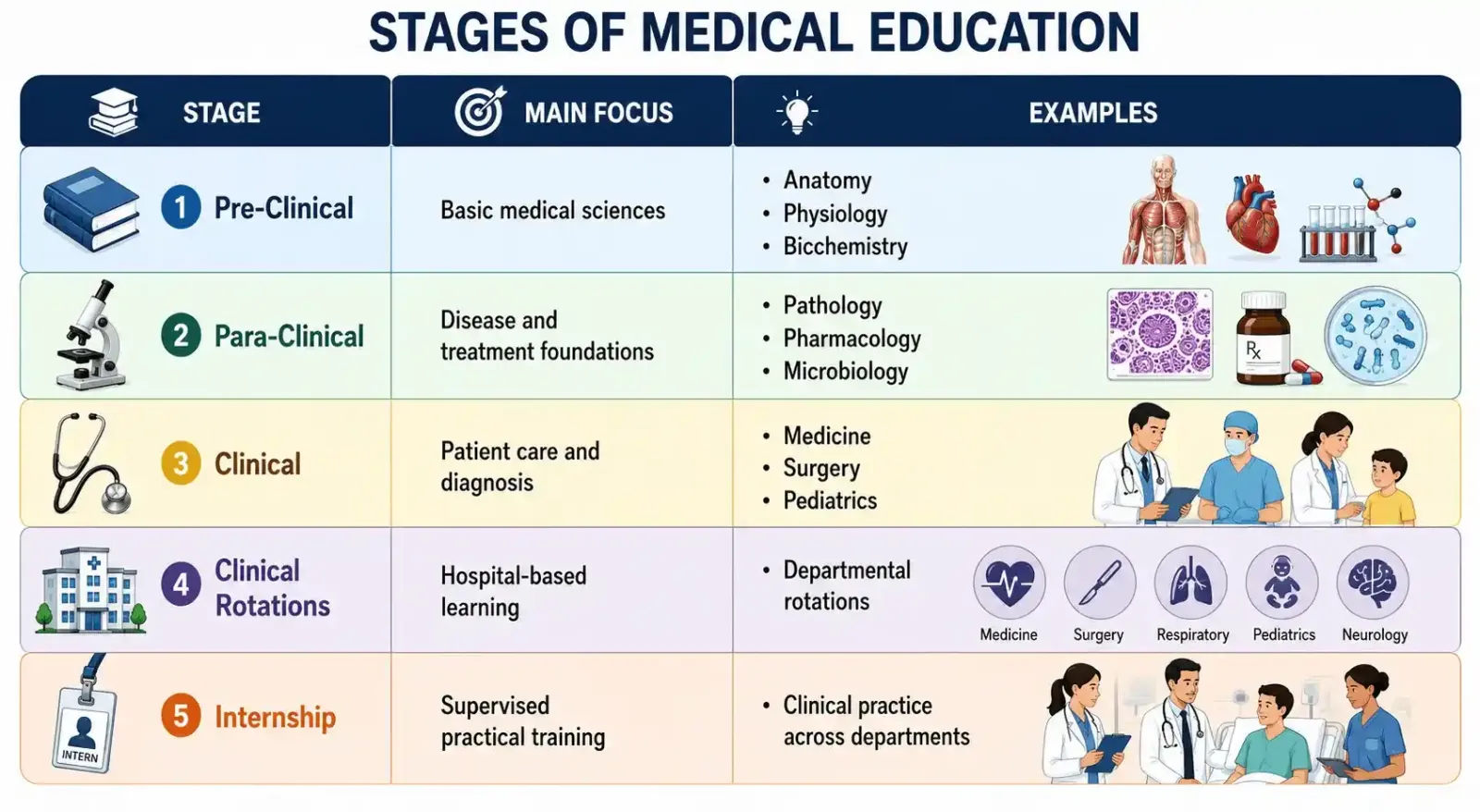
The course structure of MBBS abroad typically includes basic subjects in medical sciences as well as clinical subjects, hands-on training, and internship. The specifics of the program, including its length, coursework, and conferred degree title, may vary by country/university.
However, an MBBS overseas program may typically comprise the following stages:
In this phase of an MBBS degree abroad, students first learn basic medical sciences. They will generally blend lectures with laboratory sessions, practical classes, and introductory clinical skills.
Common subjects include:
Students in the MBBS abroad program then progress from basic sciences to understanding disease and treatment. This phase assists students in bridging the knowledge of the human body with disease processes, diagnosis, prevention, and treatment.
Major subjects may include:
Clinical education takes place predominantly in these later years of MBBS abroad. Students learn directly in clinical settings and work with patients at an early stage, all under supervision.
They might spend time in several different departments to be exposed to obtaining patient histories, physical examination, diagnosis and formulation of treatment plans, and clinical decision-making.
Common clinical subjects include:
In this stage of the MBBS degree abroad, students generally rotate through affiliated teaching hospitals and clinical departments according to the university.
These rotations allow students to:
As the quality and quantity of clinical exposure will vary across universities, students should do research on the universities' teaching hospitals, patient load, and structure of clinical rotations.
Several MBBS abroad programs also require professional internships or vocational training as part of the program. During this time, students participate in clinical work and practice under the supervision of trained doctors and other health care professionals.
It is an important opportunity to gain experience in examining patients, diagnosing them, planning treatments, performing medical procedures, writing notes, and discussing cases with patients and staff. Such supervised training is designed to help with independent medical practice, professional confidence, and practical medical skills.
The admission process for MBBS abroad is very simple and generally takes 4-8 weeks, depending on the university, country, document verification, and visa processing.
Here’s a step-by-step guide on how to take admission for MBBS overseas:
Selecting the appropriate university is a vital part of the process for pursuing an MBBS abroad. Thus, begin by comparing countries/universities based on tuition fees, eligibility requirements, course duration, recognition, clinical training, and living costs.
After selecting the country and university, students should check whether they qualify academically and meet entrance requirements. For Indian students aspiring to do MBBS abroad, NEET qualification is generally required along with the prescribed marks in Physics, Chemistry, and Biology (PCB) in class 12. However, the requirements may vary by country and university.
Now fill out the application form and submit the necessary documents. These may be academic certificates, NEET scorecard, passport, photographs, or other supporting documents.
Once the application and documents are reviewed, the university provides an admission letter or offer letter to qualifying students. This affirms their admission into the MBBS overseas program.
Students may also need to pay a tuition fee, admission fee, or registration amount to secure their place for an MBBS degree abroad. The amount and conditions of the payment vary by university.
Students can apply for a student visa after they have received the admission letter for MBBS abroad. This usually includes submitting the admission letter, passport, financial documents, medical or other necessary certificates, and other visa application formalities.
After the visa has been approved, students can book flight tickets and get ready for travel. Students must also organize accommodation and be in possession of all necessary academic and travel documents.
After reaching the destination, students complete university registration and begin their medical education. The MBBS at abroad journey typically combines classroom learning, practical training, clinical exposure, and, where applicable, internship or supervised clinical practice.
Need Complete MBBS Abroad Guidance?
From university selection to visa approval, we support you every step of the way.
MBBS abroad fees for Indian students are between Rs. 3 Lakhs and Rs. 75 Lakhs for the entire course, depending heavily on the country.
| Country | Approx. Tuition Fee Per Year (INR) |
|---|---|
| Kyrgyzstan | ₹2.86 Lakh – ₹4.29 Lakh |
| Kazakhstan | ₹4.19 Lakh – ₹4.29 Lakh |
| Uzbekistan | ₹2.38 Lakh – ₹3.33 Lakh |
| Georgia | ₹4.95 Lakh – ₹5.72 Lakh |
| Russia | ₹3.66 Lakh – ₹6.10 Lakh |
| Vietnam | ₹4.76 Lakh – ₹5.72 Lakh |
| Moldova | ₹6.60 Lakh |
| Iran | ₹1.43 Lakh – ₹3.33 Lakh |
| Tajikistan | ₹3.81 Lakh – ₹5.72 Lakh |
| Armenia | ₹3.81 Lakh – ₹5.72 Lakh |
| Egypt | ₹8.58 Lakh – ₹10.48 Lakh |
| Country | Approx. Tuition Fee Per Year (INR) |
|---|---|
| Philippines | ₹23 Lakh – ₹30 Lakh |
| Country | Approx. Tuition Fee Per Year (INR) |
|---|---|
| Nepal | ₹55 Lakh – ₹75 Lakh |
| Mauritius | ₹30 Lakh – ₹49 Lakh |
| Bangladesh | ₹40 Lakh – ₹50 Lakh |
The ideal MBBS abroad destination country is determined by the student’s budget, academic profile, preferred learning styles, and subsequent career plans.
Instead of choosing a country simply because it is popular, ask: “Does this country fit my goals and budget?”
Consider Kyrgyzstan if:
Think carefully if:
You are choosing a university solely because it offers the lowest fees. Compare clinical exposure, curriculum, facilities, teaching hospitals, and the complete cost before applying.
Consider Nepal if:
Think carefully if:
Your main objective is the lowest possible cost. Compare the complete course expenses and university-specific requirements before choosing.
Should You Consider Kazakhstan for MBBS Abroad?
Consider Kazakhstan if:
Think carefully if:
You are selecting a university based only on advertised fees without checking the complete course cost, curriculum, and clinical-training arrangements.
Consider Mauritius if:
Think carefully if:
You have not compared the total cost of education and living expenses or verified the university's recognition and clinical-training structure.
Consider the Philippines if:
Think carefully if:
You have not understood the specific admission pathway, course structure, degree requirements, and clinical-training arrangements before applying.
Consider Uzbekistan if:
Think carefully if:
You are choosing a university without checking its recognition, curriculum, teaching hospitals, clinical exposure, and requirements applicable to Indian students.
Consider Georgia if:
Think carefully if:
Your primary goal is the lowest possible total cost. Compare tuition, accommodation, living expenses, and other costs before choosing.
Consider Russia if:
Think carefully if:
You are uncomfortable with colder climates, language barriers during clinical exposure, or adapting to a different healthcare environment.
Consider Vietnam if:
Think carefully if:
You have not checked the language used during clinical training, the degree structure, university recognition, and applicable NMC/FMG requirements.
Should You Consider Bangladesh for MBBS Abroad?
Consider Bangladesh if:
Think carefully if:
You are assuming that geographical or cultural similarity automatically makes a university suitable. Always evaluate the university independently.
Consider Moldova if:
Think carefully if:
You have not verified the degree structure, medium of instruction, clinical exposure, teaching hospitals, and total course cost.
Consider Iran if:
Think carefully if:
You have not checked the language of clinical training, university recognition, degree structure, and current NMC/FMG requirements.
Consider Tajikistan if:
Think carefully if:
You are choosing solely on the basis of low fees. Check the university's clinical training, teaching hospitals, curriculum, recognition, and complete cost.
Consider Armenia if:
Think carefully if:
You have not verified the medium of instruction, clinical-training arrangements, degree awarded, and total expenses before applying.
Consider Egypt if:
Think carefully if:
You have not checked the language requirements for clinical interactions, course structure, university recognition, clinical exposure, and total cost before making a decision.
| If Your Priority Is... | Countries to Consider |
|---|---|
| Lower overall budget | Kyrgyzstan, Uzbekistan, Tajikistan |
| Relatively affordable Central Asian options | Kyrgyzstan, Uzbekistan, Kazakhstan, Russia, Tajikistan |
| European-oriented environment | Georgia, Moldova, Armenia |
| English-medium environment | Georgia, Philippines, university-specific programs |
| Geographical proximity to India | Nepal, Bangladesh |
| Multicultural international environment | Mauritius, Philippines, Georgia |
| Asian healthcare and education exposure | Philippines, Vietnam, Bangladesh |
| European-region medical education options | Georgia, Moldova, Armenia |
| North African medical education exposure | Egypt |
| Different international healthcare environments | Iran, Egypt, Vietnam |
| Lower living-cost options | Kyrgyzstan, Uzbekistan, Kazakhstan, Tajikistan |
| International career ambitions | Compare the specific country's licensing pathway |
| Returning to practice in India | Check current NMC/FMG requirements before choosing any university |
When choosing a country for pursuing an MBBS degree abroad, keep in mind the following things:
There are various career options available to Indian students who have completed an MBBS abroad. Students can later either return to India to register as a doctor and complete further studies, seek medical licensing elsewhere in the world, or pursue medical education and/or work in healthcare and other adjacent nonclinical fields.
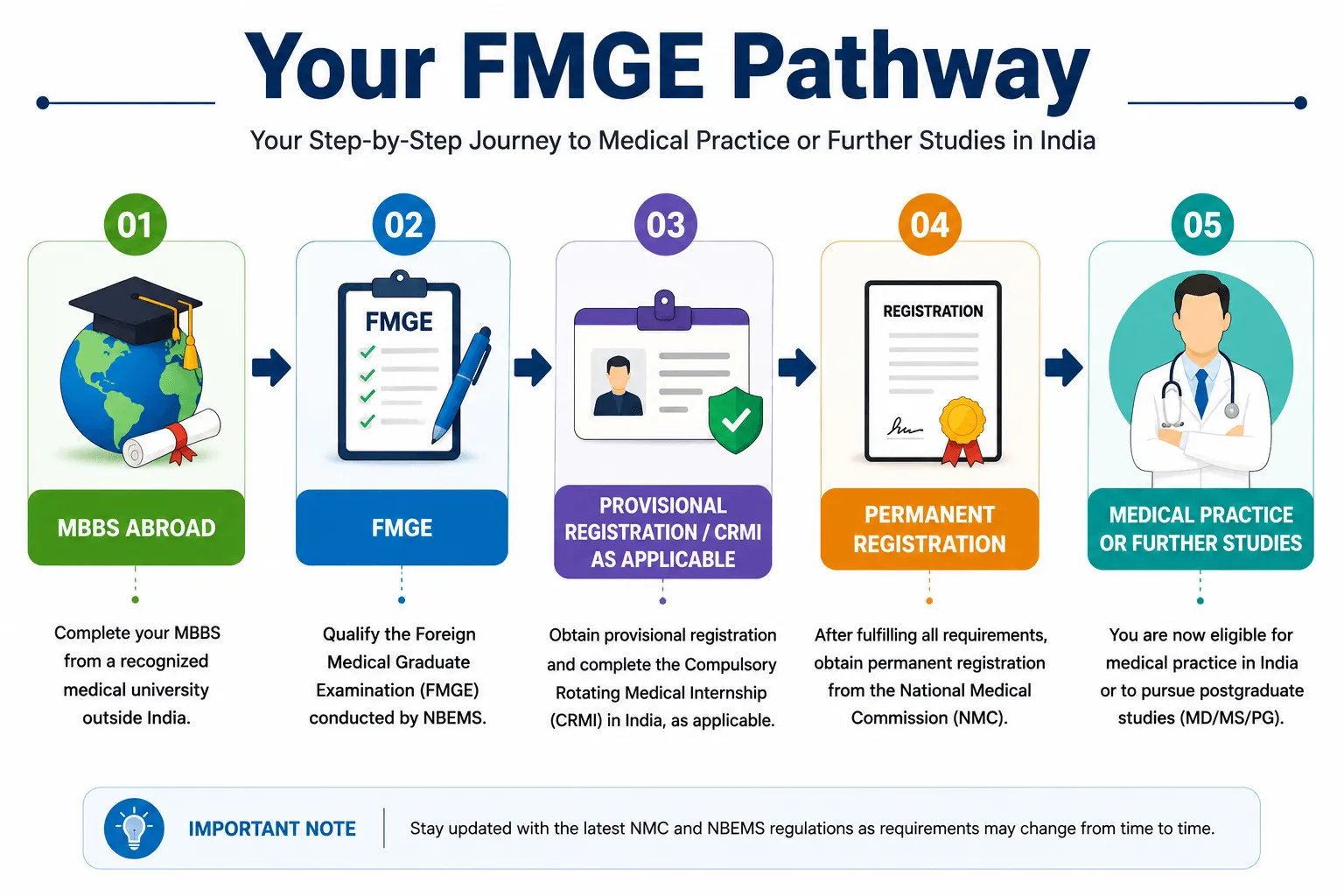
Students intending to practice medicine in India after completing MBBS abroad must complete the licensing/registration process in India. For those Foreign Medical Graduates who follow the existing pathway, this could include passing the FMGE and completing the required Compulsory Rotating Medical Internship (CRMI) and registration process. The planned NExT system will establish a shared approach to medical licensing and post-graduate medical training.
MBBS overseas graduates who meet requirements related to examination, internship, and registration are eligible to apply for clinical as well as postgraduate opportunities in India.
Some students may not intend to practice in India after doing MBBS abroad. Therefore, passing FMGE is not a prerequisite to practice medicine in another country after MBBS abroad, but graduates are responsible for meeting the licensing, examination, registration, language, and training requirements of their destination country.
A few of the more popular global pathways after MBBS abroad include:
An MBBS degree abroad does not have to imply that a graduate will need to seek out traditional clinical practice. There are many non-clinical career options that allow those clinically interested students who wish to engage in research, business, pharmaceutical, administrative, and analytical work within the healthcare system.
Any student intending to practice in India after studying MBBS abroad will specifically need to be aware of the requirements of the FMGE/CRMI/NExT as applicable to their situation. The pathway is contingent on the rules that apply to the student’s year of admission and situation.
The Foreign Medical Graduate Examination (FMGE) has long been the pathway through which many foreign medical graduates (FMGs) could achieve medical registration for practice in India. There are also NMC notices and regulations that set requirements for interns and for registered FMGs after completing their MBBS abroad.
The general pathway for FMGs that are eligible currently includes:
Key Highlights
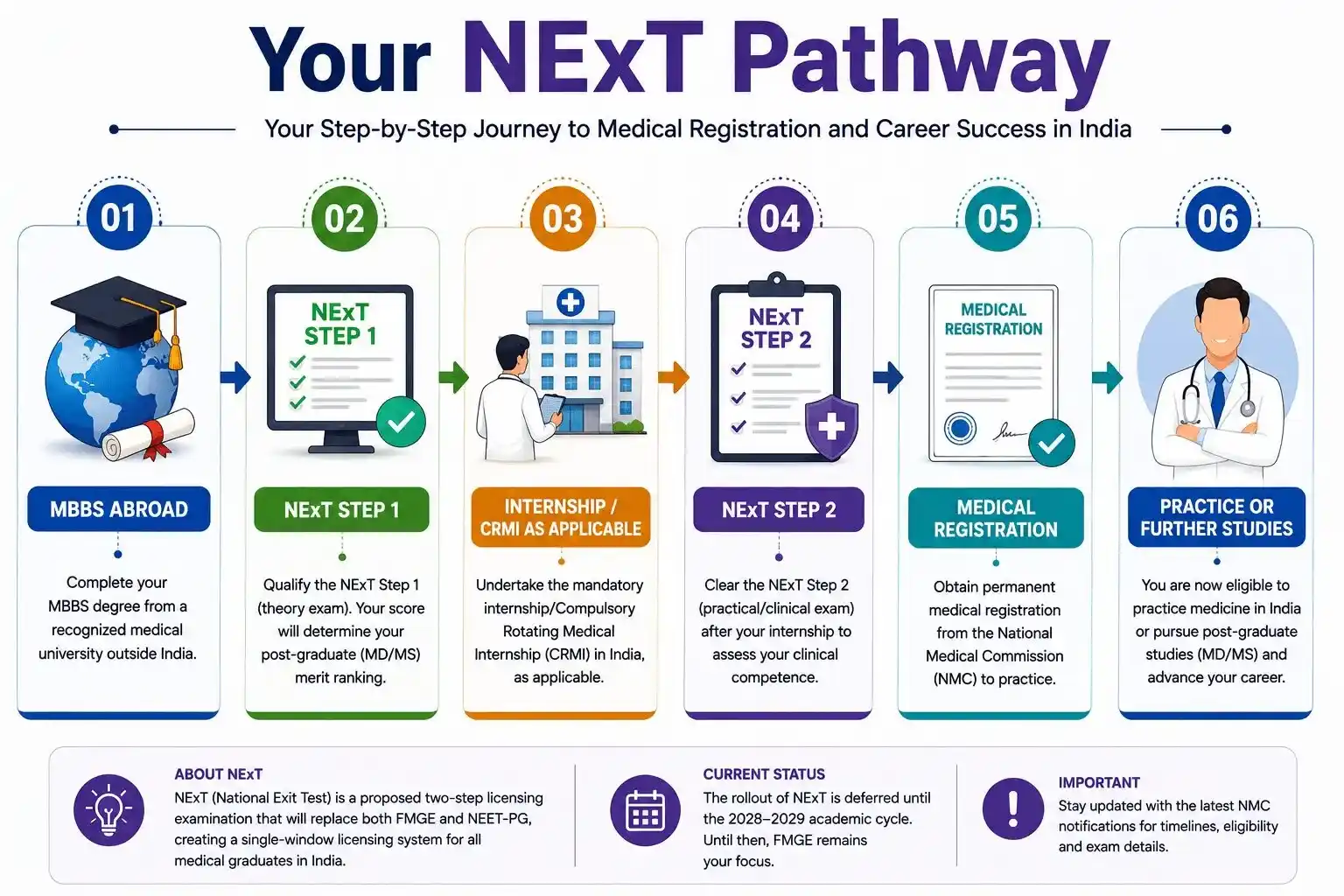
The National Exit Test (NExT) aims to establish a uniform standard for medical licensure and postgraduate medical training in India. It seeks to unify the testing process more for Indian medical graduates and Foreign Medical Graduates (FMGs).
It is important for MBBS abroad students to know about NExT as it is proposed to be the future replacement of FMGE. Students should always verify with the most recent NMC and NBEMS notifications before planning their way for applying for the license.
Current Status of NExT
The NExT implementation has been delayed. In the meantime, until NExT is actually implemented for the concerned batch, FMGE continues to be the screening test for all eligible Foreign Medical Graduates.
Thus, students who are currently pursuing or planning to pursue MBBS abroad should understand FMGE as per their batch and prepare accordingly.
The Two-Step Structure of NExT
The proposed NExT framework consists of two separate steps, each serving a different purpose.
NExT Step 1 – Theory Examination
NExT Step 1 is designed as a computer-based theoretical examination.
Key features include:
NExT Step 2 – Clinical & Practical Examination
NExT Step 2 is designed to assess practical and clinical competence rather than only theoretical knowledge.
It is proposed to include:
| Feature | FMGE – Current Pathway | NExT – Proposed Future Framework |
|---|---|---|
| Purpose | Screening examination for eligible FMGs | Common framework for licensure and PG medical education |
| Applicability | Foreign Medical Graduates | Intended for Indian and Foreign Medical Graduates |
| Structure | Single theory-based screening examination | Step 1 + Step 2 |
| Step 1 | Not applicable | Computer-based theoretical examination |
| Step 2 | Not applicable | Practical/clinical examination |
| PG Pathway | NEET-PG currently remains relevant under the existing system | NExT is intended to replace the NEET-PG pathway |
Use this checklist before paying an admission fee for your MBBS abroad program:
Academic
University
Regulatory
Financial
Career
There is no one official success rate for students studying MBBS abroad, as success can mean completing the medical degree, clearing the licensing examination, obtaining registration, entering post-graduate training, or being able to practice medicine.
But passing the FMGE is one of the most salient measurable goals, particularly for Indian Foreign Medical Graduates hoping to practice in India after completing MBBS abroad. According to the Ministry of Health & Family Welfare, from 2004 to 2024, 96,545 students passed the FMGE, as per data provided by the National Board of Examinations in Medical Sciences (NBEMS).
The above figure indicates that a significant number of foreign-trained medical graduates who pursued MBBS overseas have successfully completed the licensing hurdle and moved towards practicing medicine in India.
Here are a few documented examples of Indian medical graduates who studied abroad and subsequently progressed into medical careers.
Case 1: Dr. Deepak Anjana - From MBBS Abroad to Medical Practice in India
Dr. Deepak Anjana is an Indian medical graduate who obtained his MBBS degree internationally and has since developed a medical career in India. As his professional profile indicates, he attended the International School of Medicine in Bishkek, Kyrgyzstan, from 2015 through 2020. His bio also lists him as an FMGE and reflects his journey as a doctor after completing MBBS abroad.
Having attended medical school in Kyrgyzstan, Dr. Aanjna returned to India and completed the licensing and internship route. His public professional records indicate that he did an internship at MGM Medical College, Indore, from February 2021 until February 2022. He then worked as an MBBS doctor at Suyash Hospital in Indore and then as a Medical Officer in the National Health Mission, Department of Public Health and Family Welfare, Government of Madhya Pradesh.
His profile also states that he FMGE qualified in 2020, which provides evidence of the route that many Indian students studying abroad in order to study medicine eventually hope to take: to complete an MBBS degree abroad and qualify the relevant screening exam and internship, after which one can procure a medical position in India.
Dr. Aanjna has also publicly documented his experiences, including preparing for medical licensing and postgraduate exams. His public record indicates that he later got into medical education and test prep, developing a virtual study platform for would-be doctors.
Case 2: Dr. Arif Khan - From India to Becoming a Doctor in Russia
Dr. Arif Khan is an Indian medical student who completed his MBBS degree abroad (Russia). His journey is documented in an interview conducted in Salekhard, Russia, where he describes his past, the choice to go into medicine in the former Soviet/Russian system, his time as a medical student, and his work life as a doctor.
What makes his experience so applicable to students interested in pursuing MBBS abroad is that his story offers an alternative path: instead of immediately returning to India after becoming a doctor, he remained and practiced in Russia, working within the Russian healthcare system.
In his interview, Dr. Khan speaks about his experience with medical education in Russia, the shift from being a student to being a working doctor, doctors’ working conditions, salaries, expectations of doctors, and practicing medicine in India versus Russia.
His experience also highlights an important point for students thinking about MBBS abroad; career opportunities after medical graduation depend heavily on the country in which a graduate intends to practice. A foreign medical degree does not entitle one to practice medicine everywhere. Therefore, graduates must meet the licensing, registration, language, and other professional requirements of the country they choose to work in.
Studying MBBS abroad is not just about studying in a country with cheaper fees or an easier admission process; it is also about choosing a medical degree that suits your budget, your academic ambitions, your career plans, and ultimately your licensing process.
From university recognition and clinical exposure to living costs, FMGE/NExT, internship, registration, and PG life, every decision carries weight for what happens after MBBS abroad. The right choice, therefore, is not necessarily the cheapest or most popular university, but the one that offers a clear, credible, and practicable route from medical student to practicing doctor.
Ready to Start Your MBBS Abroad Journey?
Make the right choice today.
The FMGE pass rate varies between examination sessions. Students are advised to check the latest official NBEMS results instead of believing any university or coaching-center claims.
Not at all. It depends on where you want to practice. As for Indian students who wish to return to India to practice, they will have to follow the applicable FMG licensing requirements, which currently include the FMGE for the eligible FMGs.
You cannot practice medicine in India without following the necessary licensing and registration requirements. While waiting for your new eligibility period to begin, you can also consider non-clinical careers that may interest you.
Do your own research about the MBBS abroad university before making a payment. Verify the following:
It varies between universities and licensing routes. For students going back to India, the path is MBBS abroad → licensing requirements → internship → registration → practice/PG, so it does not end at graduation.
Don’t let a friend’s experience make up your mind for you. Compare MBBS abroad university fees, clinical exposure, eligibility, facilities, and career pathways according to your own goals.
Teaching in the academy for MBBS abroad may take place in English; however, having some local language skills can greatly help day-to-day life and the delivery of clinical care. However, requirements differ by country and university.
Most of the application process, documentation, counseling, and visa process can be done from India. But at some point, you will have to go abroad to finish the MBBS abroad and your clinical training.